by Jordan Stocker | Jan 29, 2026 | Housing News
Governor Healey has released her FY2027 (FY27) budget proposal, known as House 2 (H2). The proposal totals $60.114 billion in line-item spending excluding Fair Share surtax spending and the Medical Assistance Trust Fund, an increase of $2.015B (3.5%) over the FY26 General Appropriation Act (GAA).
Revenue & Budget
H2 is built on a $44.9B consensus tax revenue forecast (including $2.7B from the Fair Share surtax), with the remaining spending supported by other non tax revenue sources such as federal funds and other dedicated revenues.
A side-by-side overview of key housing line items, including FY26 GAA amounts, the Governor’s FY27 H2 proposal, and CHAPA’s funding asks, is available in CHAPA’s FY2027 Budget Tracker. The tracker will be updated as the budget moves through the House and Senate.
Affordable Housing Priorities
CHAPA is encouraged that, even in a tight fiscal environment, the Governor’s proposal continues to direct significant resources toward housing stability. The Administration highlights $1.2 billion in targeted investments at the Executive Office of Housing and Livable Communities (EOHLC).
Here are the funding levels for some of the key rental assistance and housing stability programs in the budget:
- MRVP (Massachusetts Rental Voucher Program) (7004-9024)
- FY26 GAA: $253,311,840
- FY27 H2: $278,341,728
- The Administration says this level is expected to support 11,500+ vouchers, including 340+ project-based vouchers.
- AHVP (Alternative Housing Voucher Program) (7004-9030)
- FY26 GAA: $19,461,214
- FY27 H2: $19,263,183
- The appropriation provide rental assistance through 890+ vouchers for persons with disabilities.
- Updated Budget language: Outside Section 72 updates the AHVP statute to better align with MRVP, confirms AHVP can be issued as mobile or project-based vouchers, and places AHVP under EOHLC’s voucher-program authority by regulation rather than in the public housing statute framework.
- RAFT (Residential Assistance for Families in Transition) (7004-9316)
- FY26 GAA: $207,477,715
- FY27 H2: $201,205,991
- A crucial short-term eviction-prevention program and homelessness prevention program serving about 47,000 households each year.
- HomeBASE (7004-0108)
- FY26 GAA: $57,322,001
- FY27 H2: $82,322,001
- A state housing stabilization program that helps families leave Emergency Assistance shelter and stay housed by providing temporary financial help (up to $30,000 over two years) and case management support.
Homelessness, Shelter, and Housing Stabilization
H2 recommends $150M for programs supporting individuals experiencing homelessness (a 9% increase above FY26 GAA).
Key shelter and stabilization items include:
- Winter Beds (7004-0111): $12M to support 800 additional shelter beds.
- Homeless Individual Shelters (7004-0102): $114M to enable 2,800 shelter beds, plus day programming capacity (about 600 people), outreach, meals, and other supports.
- EA (Emergency Assistance Family Shelter and Services) (7004-0101): $259M, a 6% decrease below FY26 GAA, alongside $5M for security and accessibility grants (including upgrades like cameras, door alarms, and lighting improvements).
- Family Shelter Diversion (7004-0110): $7.5M, described as a distinct diversion program using flexible financial assistance to help divert families from shelter.
Public Housing
For state public housing, the H2 proposal includes two main line items:
- Public Housing Operating (7004-9005)
- FY26 GAA: $115,600,000
- FY27 H2: $117,810,000
- Public Housing Reform (7004-9007)
- FY26 GAA: $1,250,000
- FY27 H2: $1,269,215
What’s next
The Governor’s proposal is the first step in a long budget process that now moves to the Legislature. While H2 maintains important housing investments, more must be done to meet the scale of housing need, especially as costs continue to rise and far too many Massachusetts residents struggle to find a home they can afford.
Over the coming months, CHAPA will be working with members and partners to advocate for the funding needed to address housing challenges across the Commonwealth. For a more detailed discussion of the Governor’s FY27 H2 proposal and to plug into shared advocacy strategy, please join the Building Blocks Coalition. The next Building Blocks Coalition meeting will be March 25th and you can register for the meeting here.
by Jenna Connolly | Jan 29, 2026 | Housing News
Today, Attorney General Andrea Campbell filed suit against the towns of Dracut, East Bridgewater, Halifax, Holden, Marblehead, Middleton, Tewksbury, Wilmington, and Winthrop, seeking to achieve full municipal compliance with the MBTA Communities Act. While the vast majority of MBTA Communities—165 out of 177—have already met the Act’s landmark multi-family zoning requirements, the nine towns named in this suit have violated the law by refusing to create districts for multi-family housing.
“With this lawsuit, Attorney General Campbell reaffirms her commitment to creating a Massachusetts where everyone can find a home they can afford in the community they choose,” said Rachel Heller, chief executive officer of Citizens’ Housing and Planning Association (CHAPA). “Massachusetts needs to build 222,000 homes by 2035 to meet the needs of residents, our neighborhoods, and our economy. We thank Attorney General Campbell for ensuring that every MBTA Community is following this important law that puts the Commonwealth on the path to a bright future where everyone can thrive.”
In the five years since Governor Charlie Baker signed the MBTA Communities Act into law, state agencies have offered municipalities ample time and resources to attain local compliance. The Executive Office of Housing and Livable Communities provided at least 157 MBTA Communities with more than $7.8 million in grants designed to help officials draft new zoning districts that align with their local needs and comply with state law. Additionally, CHAPA itself has provided direct technical support to over 80 communities, both to help them understand the law’s requirements and engage their communities in shaping multifamily districts.
“Massachusetts Courts have repeatedly confirmed that the MBTA Communities Act is the law of the land,” said CHAPA’s general counsel for policy, Jacob Love. “We expect a judge to swiftly rule in favor of the Attorney General and bring the nine named towns into compliance. Allowing more homes in MBTA Communities is a win for all Massachusetts residents and will help us meet the state’s housing needs.”
Already, nearly 7,000 new homes have entered the pipeline in zoning districts adopted to comply with the MBTA Communities Act, providing potentially thousands of people—families, young adults, downsizing seniors, and more—with opportunities to find homes that fit their needs in Massachusetts.
by Jordan Stocker | Jan 28, 2026 | Housing News
The Executive Office of Housing and Livable Communities (EOHLC) released a January 2026 memo that makes targeted changes to the current 2025–2026 QAP, which sets the state’s guidelines for awarding Low-Income Housing Tax Credits (LIHTC).
The memo extends the 2025–2026 QAP through 2027 so the same overall framework stays in place longer, with the goal of maintaining “as much consistency as possible” during an “ongoing period of unprecedented challenges.” It also clarifies that, aside from the specific amendments described in the memo and its attachments, the rest of the 2025–2026 QAP remains in full effect.
Key Changes
- Accessibility: The memo adds a new requirement for new construction elevator projects by requiring sponsors to include at least 10% fully accessible units, and it strongly urges sponsors of adaptive re-use and/or moderate rehabilitation projects to include more fully accessible units than code or statute requires.
- Green building standards (EGC and alternatives): The memo keeps Enterprise Green Communities Certification Standards (EGC) as the baseline sustainability requirement for LIHTC projects, but allows sponsors to request a written waiver to use a widely accepted comprehensive alternative standard, with LEEDv cited as an example.
- Passive House documentation: For sponsors pursuing Passive House certification, the memo allows an architect self-certification stating the project will meet EGC or an HLC-approved alternative, and it specifies that if Passive House is not achieved, the sponsor must still submit an architect certification that EGC or the approved alternative is met.
- Fees (Attachment #1): The memo states the LIHTC fee schedule has not changed for approximately 15 years and that HLC will require modest increases, with the modified fee schedule provided in Attachment #1.
- Federal changes (“The Reconciliation Bill”): The memo cites July 2025 federal legislation affecting 9% and 4% LIHTC, including approximately $3 million in additional 9% authority for Massachusetts during 2026 and 2027, and it notes that revised 4% LIHTC language is included in Attachment #2 and is effective immediately.
- Competition timing: The memo provides an updated schedule for funding rounds, including a first 2026 competition beginning with One Stop applications due March 19, 2026, an anticipated second 2026 competition with a NOFA in August 2026, and an anticipated 2027 high-readiness competition with deadlines to be announced later.
Next Steps
Members of the public who want to weigh in can contact Christopher LaGrutta at [email protected] to request the virtual hearing link and access instructions, participate in the 11:00 AM January 29, 2026 virtual hearing, and/or submit written comments before the hearing and for five business days afterward.

by Jordan Stocker | Jan 27, 2026 | Housing News
Recently, three special commissions established through the Affordable Homes Act released final reports with recommendations on extremely low-income housing, accessible housing, and senior housing. CHAPA was among the several organizations that participated in the Special Commission on Extremely Low-Income Housing
The Extremely Low-Income Housing report focuses on households with incomes at or below 30 percent of area median income. It reports that Massachusetts had approximately 470,000 extremely low-income households as of 2023, including about 320,000 renter households. The report also cites National Low Income Housing Coalition estimates of a 183,253-unit shortage of homes affordable to extremely low-income households, based on 44 affordable units for every 100 extremely low-income households.
The commission calls for strengthening the Commonwealth’s rental assistance tools by expanding MRVP with 4,400 additional vouchers each year, split between 2,200 project-based and 2,200 mobile vouchers, and it recommends investing in supporting and sustaining effective tenant organizations. It also recommends codifying MRVP in Massachusetts General Laws, improving statewide data on homes affordable to extremely low-income households, continuing and increasing investments in RAFT, renewing the Tenancy Preservation Program, and establishing an upstream rental assistance pilot. MRVP is also a throughline across the other two commission reports, reflecting how important rental assistance is for supporting stability across populations. Together, the three reports point toward a practical, forward-looking roadmap to help more people stay stably housed, with supports that reflect how needs intersect across income, age, and disability.
Reports:
by Jenna Connolly | Jan 21, 2026 | Housing News
The Massachusetts Executive Office of Housing and Livable Communities (EOHLC) released 2026 guidelines for its Housing Choice Designation, an initiative that rewards pro-housing municipalities with exclusive grant opportunities.
The initiative includes two designation options: the Housing Choice Community (HCC) Designation and the recently announced Rural and Small Town Housing Choice Community (RST-HCC) Designation. Communities are encouraged to learn more about the designation and its benefits, along with the HCC and RST-HCC criteria and best practices. EOHLC is also offering 1-on-1 technical assistance office hours for any city or town with questions before submitting an application.
EOHLC named CHAPA’s Massachusetts Housing Leadership Academy and Housing Summit as official best practices, meaning when local officials participate in the Academy or attend the Summit, they bring their communities closer to unlocking exclusive state grants that can fund local planning, infrastructure, and the creation of new housing.
CHAPA is grateful for EOHLC’s selection of our programming, and we look forward to training many more local officials in the years to come!
Applications for the 2026 Housing Choice Initiative Designation are due by February 27, 2026. EOHLC will host two guidance webinars on January 27: an HCC Designation Guidance webinar (11:00 AM to 12:00 PM) and a RST-HCC Designation Guidance webinar (2:00 PM to 3:00 PM). Questions can be directed to McKenzie Bell at [email protected].
by Jenna Connolly | Jan 8, 2026 | Housing News
This week, Secretary of State Bill Galvin announced that all four proposed ballot measures seeking to weaken or repeal the MBTA Communities Act did not receive enough signatures to advance, providing more evidence of Massachusetts voters’ strong support for creating more homes near transit. Citizens’ Housing and Planning Association (CHAPA) celebrates this milestone as a victory that will ensure the continued efficacy of this landmark housing law and as another strong indication that Massachusetts voters are committed to taking action to solve the Commonwealth’s housing shortage.
“Massachusetts must build 220,000 new homes by 2035 to meet demand and stabilize housing prices, and the MBTA Communities Act is an essential part of achieving that goal,” said Rachel Heller, CHAPA’s chief executive officer. “The MBTA Communities Act will create more opportunities for people to buy their first homes, for seniors to downsize, and for teachers, firefighters, and small business owners to live in the communities they serve. We all benefit when people have choice in where they call home.”
An overwhelming majority of 93%—165 out of 177—MBTA Communities have adopted districts to comply with the law, creating opportunities for new homes near transit. According to the Executive Office of Housing and Livable Communities, over 6,000 new homes are already in the development pipeline as a result of this law.
Despite unsuccessful ballot campaigns and legal challenges, the MBTA Communities Act has consistently enjoyed widespread popularity among Massachusetts voters. In a 2024 poll conducted by WBUR and Commonwealth Beacon, 50% of respondents said the law is good policy, while only 31% said it is not. Furthermore, a recent poll from MassINC and Abundant Housing Massachusetts found that 79% of voters support building more homes near transit statewide.
“The residents of MBTA Communities whom we’ve worked alongside have consistently told us that housing is their number one issue,” said Lily Linke, CHAPA’s director of municipal engagement. “The MBTA Communities Act allows municipalities to plan for the growth they need to meet demand where it makes sense for their unique circumstances.”
Signed into law by then-Governor Charlie Baker in 2021, the MBTA Communities Act requires all municipalities served by the MBTA to designate an area where property owners can legally build apartments, townhomes, and other types of mid-scale multifamily housing.

by Jenna Connolly | Jan 8, 2026 | Featured News, Housing News
We write to share important news about a leadership transition at Citizens’ Housing and Planning Association (CHAPA). After 13 years of dedicated service to CHAPA, including nine years as our Chief Executive Officer, Rachel Heller will be stepping down from her role to become the next Executive Director of Massachusetts Housing Partnership (MHP).
During Rachel’s tenure, CHAPA has grown stronger as a leading voice and convener for the affordable housing and community development field. Under her leadership, CHAPA expanded its advocacy to advance equitable housing opportunities, built new partnerships with diverse stakeholders statewide, and strengthened the organization’s commitment to ensuring affordable housing and choice in every community. While we will deeply miss Rachel’s vision, energy, and steadfast leadership, we are thrilled that she will continue to shape the future of affordable housing in Massachusetts through her new role at MHP.
“On behalf of CHAPA and key Massachusetts housing stakeholders, we are deeply grateful for Rachel’s impactful leadership over the last thirteen years. She both stewarded and expanded CHAPA’s important legacy of advocacy for safe, affordable, and welcoming homes statewide so everyone has a place to call home in the communities they choose,” said Leslie Reid, CHAPA President and Chief of Investment Programs at Massachusetts Housing Investment Corporation. “We are thrilled that she will continue to advance important initiatives toward greater affordable housing access and opportunity for all residents as Executive Director at Massachusetts Housing Partnership.”
CHAPA’s Board of Directors will soon begin a search process for our next CEO. Please stay tuned for the job posting next week. Rachel will continue as CHAPA CEO’s until the last week of February, when our Chief Operating Officer, Maritza Crossen, will step in as Interim CEO. In the meantime, please join us in congratulating Rachel on this exciting new chapter and in celebrating her many contributions to CHAPA and the affordable housing field.
We have so many exciting ongoing initiatives at CHAPA, and we will continue to move full steam ahead towards our strategic goals. Please join us at the upcoming federal forum and the Housing Policy Action Center’s research webinar. Continue to advocate with us for state legislation and budget priorities that further affordable housing opportunity, equity, and access. Our brand new Massachusetts Housing Leadership Academy has kicked off with its first cohort of community leaders dedicated to creating thriving communities, and we can’t wait to share more updates with you as this program progresses.
by Jenna Connolly | Nov 21, 2025 | Featured News, Housing News
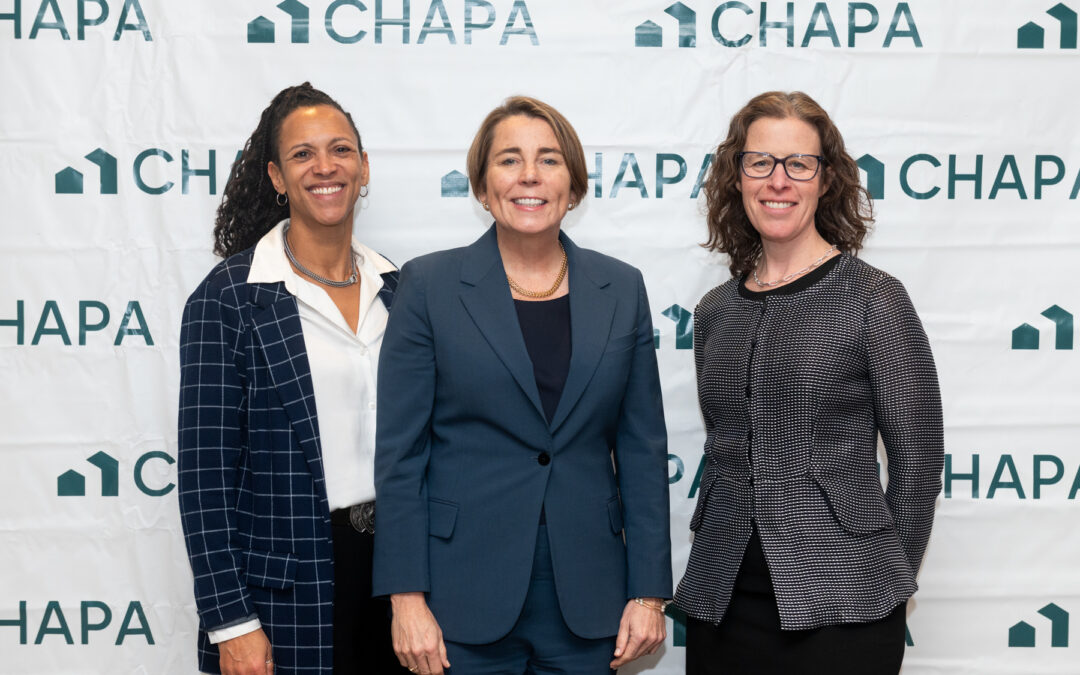
Over 400 housing leaders from across the Commonwealth, including Governor Maura Healey, Lieutenant Governor Kim Driscoll, and Executive Office of Housing and Livable Communities Secretary Ed Augustus, convened yesterday to shape how the Commonwealth can boost our housing production and meet the state’s goal of 222,000 homes by 2035. Hosted by Citizens’ Housing and Planning Association (CHAPA), the Housing Summit featured experts in modular housing, infrastructure, and climate innovation who presented creative solutions to meet the Commonwealth’s housing shortage.
“It was inspiring to join so many thoughtful and committed leaders at the CHAPA Summit who have been strong partners in our efforts to make housing more affordable across Massachusetts,” said Governor Maura Healey. “With CHAPA’s support, we’ve made significant progress — passing the Affordable Homes Act, legalizing ADUs by right, creating an Office of Fair Housing and setting the first ever statewide housing production goal. Thanks to this work, we have nearly 100,000 housing starts already underway and we’re going to continue our partnership to build more housing and lower costs for the people of Massachusetts.”
The Summit opened with a panel led by Secretary Augustus and his colleagues from across sectors: Commissioner Adam Baacke, DCAMM Undersecretary for Environment Stephanie Cooper, Undersecretary of Labor Josh Cutler, and Chief Melissa Hoffer. The panel explored how the Commonwealth can work together as a state to meet Massachusetts’ housing goals. Senator Julian Cyr and Representative Andy Vargas gave opening remarks after the panel.
“The Healey-Driscoll Administration knows that we need to accelerate housing production right now to bring down costs and provide relief to renters and homeowners navigating the tight housing market,” said Ed Augustus, Secretary of Housing and Livable Communities. “As we look to what’s next for housing in Massachusetts, we are grateful to CHAPA and today’s summit for convening the best minds in housing policy to brainstorm new solutions and deliver impact.”
Other topics explored during the event included exploring how strategic land reuse, such as the Yes in God’s Backyard (YIGBY) legislation, can dramatically increase housing capacity across the Commonwealth, using innovative construction methods, such as Mass timber, to build sustainable housing faster, and finally how developers will obtain the capital and train the workforce to build the housing needed in communities across the state. Visit the Housing Summit website for the full event agenda with panel topics and speakers.
Building on the lessons learned from the Summit, CHAPA will lead efforts to turn insights into action, creating tangible outcomes that help thousands of Massachusetts residents gain and maintain stable housing.
Summit attendees also heard from experts from Nectar Community Investments, Reframe Systems, Way Finders, Metropolitan Area Planning Council (MAPC), Massachusetts Housing Partnership (MHP), Devens Enterprise Commission, BLD Properties, Northern Middlesex Council of Governments (NMCOG), Community Economic Development Assistance Corporation (CEDAC), Boston Communities, Mass Cultural Council, The Lynch Foundation, the Office of Real Estate Management Division of Capital Asset Management & Maintenance (DCAMM), Father Bill’s & MainSpring, ISC Massachusetts, Boston Housing Authority, Beacon Communities, Allston Brighton Community Development Corporation, Massachusetts Community Climate Bank, Causeway Development, National Housing Crisis Task Force, CREA, State Street, MassHousing, Massachusetts Housing Investment Corporation (MHIC), ICON Architecture, City of Boston, Massachusetts Clean Energy Center, Preservation of Affordable Housing (POAH), Stantec, National Development, Massachusetts Department of Environmental Protection (MassDEP), Harvard University, Graduate School of Design, Capstone Communities, WoodWorks – Wood Products Council, Monte French Design Studio, Code Red Consultants, Leggat McCall Properties LLC, NEI General Contracting, MassINC Policy Center, Just A Start, and Massachusetts American Federation of Labor and Congress of Industrial Organizations (AFL-CIO).
by Jordan Stocker | Nov 13, 2025 | Housing News
This week, the Boston Foundation, Boston Indicators, and Boston University released the 2025 Greater Boston Housing Report Card , offering a detailed look at how the region’s housing market is changing and where challenges remain. The report indicates that while Greater Boston is making progress, the region’s housing pressures are still severe. Home prices and rents have leveled off in 2025 but remain near record highs. A household that needed $98,000 to buy a modest home in 2021 now needs more than $160,000, and only a small share of renters can afford to buy. Since 2020, Greater Boston has added more than 70,000 new homes, but new building permits are down 44 percent since 2021, signaling a slowdown in future supply. Homelessness also remains high, and while fewer families are currently in shelters, the report notes that it is not yet clear whether families are finding stable housing, relocating, or moving into other temporary arrangements.
These findings highlight both the scale of the challenge and the importance of continuing to advance the tools now available to communities. The Affordable Homes Act is strengthening Massachusetts’ ability to build and preserve affordable housing, modernize public housing, and support renters through new investments and programs. And across the state, 158 communities have now adopted local zoning that allows more multi-family homes near transit through the MBTA Communities Act, helping neighborhoods grow in ways that improve access to jobs, reduce long commutes, and make it easier for people to stay connected to opportunity.
Reaching the goal of 222,000 new homes by 2035 will take commitment, creativity, and collaboration at every level of government and across every community. By building on what works and following through on our shared goals, Massachusetts can ensure that everyone has a safe, stable home in the community of their choice.
View the full report here.

by Jenna Connolly | Nov 6, 2025 | Featured News, Housing News
Citizens’ Housing and Planning Association (CHAPA) opened applications for its new Massachusetts Housing Leadership Academy, a six-month fellowship designed to empower local officials with the knowledge, skills, and network to create more homes for people of all ages, incomes, and abilities in their communities. With a housing shortage of 222,000 new homes needed by 2035 and local decision-making determining much of the Commonwealth’s development, strengthening the voices of pro-housing municipal leaders will benefit Massachusetts’ communities, people, and economy.
“When we work towards creating more housing in every city and town, teachers, nurses, and firefighters can afford to live near their workplace. People can downsize in the communities they love. College graduates can come home,” said Rachel Heller, CHAPA’s chief executive officer. “The Massachusetts Housing Leadership Academy will prepare local leaders to meet the housing needs of all members of their communities so everyone can thrive.”
CHAPA’s Academy is free and open to: Mayors, City and Town Councilors, Planning and Select Board Members, Finance Committee members, and any members of boards and commissions who can impact housing. The Academy’s curriculum will cover the history and causes of the Commonwealth’s housing shortage, municipal solutions, and strategies for taking those solutions from idea to implementation. Fellows will benefit from monthly virtual workshops with housing experts, monthly cohort meetings, and more.
The Massachusetts Housing Leadership Academy builds upon CHAPA’s proven community engagement model. CHAPA’s Municipal Engagement Initiative, a program supporting local pro-housing coalition-building, has worked in 45 communities since 2018 with groups like Engine 6 in Newton and the Greater Newburyport Housing Choice Coalition. In 2023, CHAPA expanded its reach to offer free technical assistance and community engagement to planners seeking compliance with the MBTA Communities Act. 97% of the 85 communities CHAPA supported have now achieved compliance.
“Proactive, inclusive, and informed community engagement can move the needle on creating more housing opportunities,” said Lily Linke, CHAPA’s director of municipal engagement. “From the Cape to the Berkshires, there are countless elected and appointed local officials who are dedicated to solving their communities’ housing challenges, and the Massachusetts Housing Leadership Academy can provide them with the tools they need to succeed.”
The first fellowship of the Massachusetts Housing Leadership Academy will run from January to June 2026. Those interested in the Academy can apply or nominate an official in their community at bit.ly/MAHousingLeadershipAcademy until December 15, 2025.