by Matt Noyes | Aug 20, 2026 | Housing News
On Thursday, CHAPA submitted a letter to the six members of the 2026 Economic Development Bill Conference Committee, outlining top housing priorities in the legislation. This bill includes several policy and funding opportunities to address Massachusetts’ housing challenges, including:
- Yes In God’s Back Yard (YIGBY)
- Duplexes As-Of-Right
- Codification of Site Plan Review
- Incentives for Commercial to Residential conversions
- Funding for first-time homeownership development
Conference committee members have until January to reconcile differences between the House and Senate versions of the legislation.

by Jacob Love | Aug 18, 2026 | Featured News, Housing News
The Massachusetts House and Senate have now passed separate versions of the 2026 Economic Development Bill, sending those versions to a Conference Committee that will negotiate a single, final Bill.
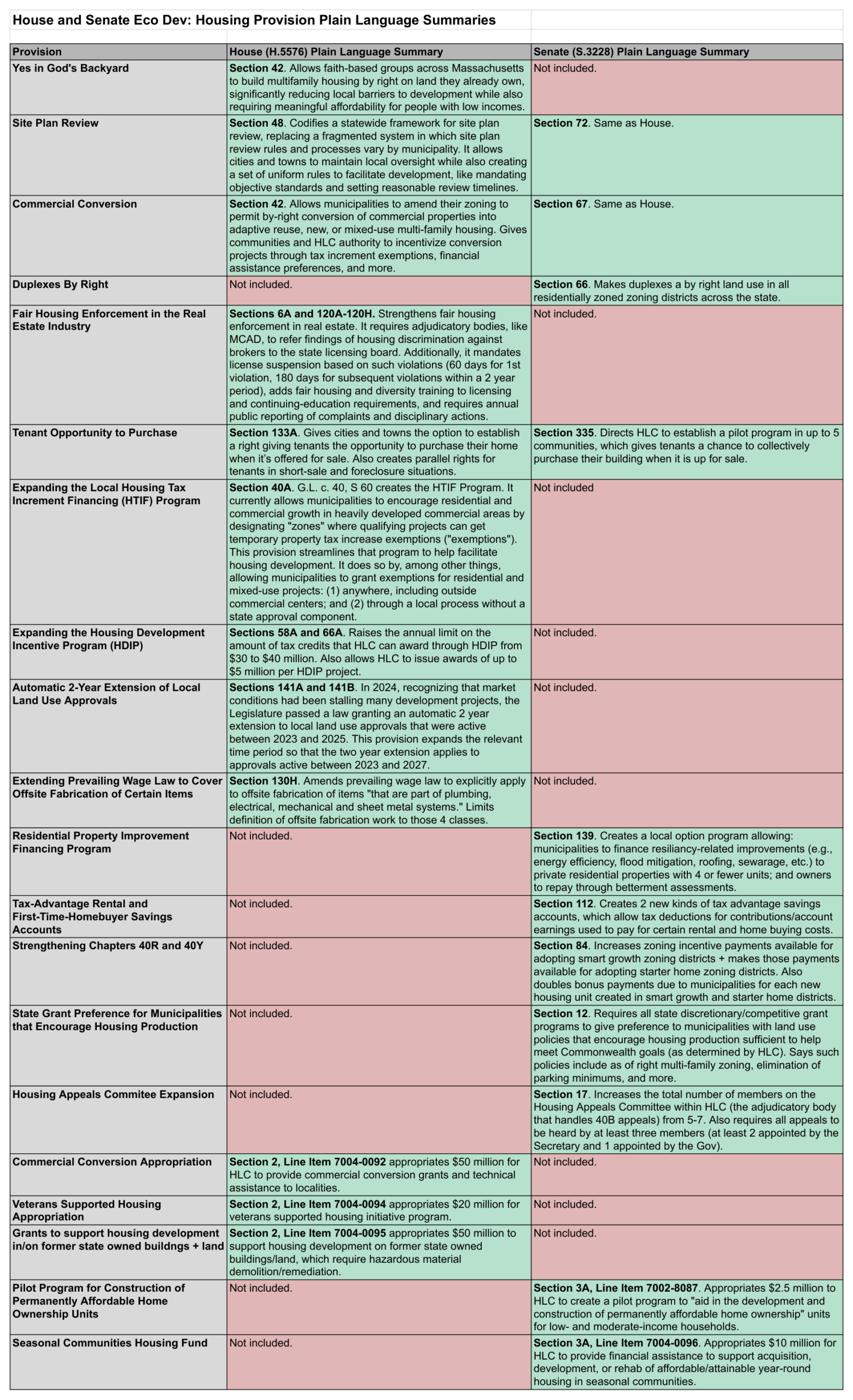
Each version of the Bill currently before the Conference Committee includes a different set of housing provisions. To help legislators, advocates, and the public parse the housing policies under consideration at this stage, CHAPA has prepared a side-by-side comparison chart with summaries of the housing items contained in each version of the Bill:
by Jordan Stocker | Aug 4, 2026 | Housing News
The Massachusetts House and Senate have each now passed their own version of the 2026 Economic Development Bill, sending it to a conference committee that will negotiate a single, final version. With formal sessions wrapping up this month, this is one of the last vehicles left this year that can move meaningful housing policy across the finish line.
Both versions carry a substantial set of measures aimed at growing the state’s housing supply. CHAPA thanks the leadership in both branches for keeping housing front and center as this bill took shape.
Conference Committee
The House and Senate have named the conferees who will negotiate the final bill:
House
- Rep. Aaron Michlewitz
- Rep. Carole Fiola
- Rep. Michael Soter
Senate
- Sen. Barry Finegold
- Sen. Michael Rodrigues
- Sen. Peter Durant
Some of CHAPA’s top housing priorities passed in only one chamber’s bill, which means the conference committee will decide whether they become law. CHAPA is urging the conferees to include these three priority policies in the final bill:
Yes In God’s Back Yard (YIGBY) – In the House bill – The House bill lets religious institutions build multifamily housing as-of-right on land they already own, without the special permits or discretionary approvals that local zoning so often requires. Development must include meaningful affordability — at least 20 percent of the units reserved for households earning no more than 80 percent of area median income — and projects near transit are freed from parking mandates. Faith communities across Massachusetts hold significant amounts of underused land, and this policy would help turn it into homes.
Duplexes as-of-right – In the Senate bill – The Senate bill makes two-family homes allowed as-of-right in every residentially-zoned district in the state. By legalizing this modest, naturally more affordable housing type everywhere — rather than leaving it to a project-by-project approval fight — the policy has the potential to create thousands of new homes and give more families an attainable option in more communities.
Site plan review – In both bills – Both bills establish a single statewide framework for site plan review, replacing the town-by-town patchwork that makes permitting slow and unpredictable today. The framework keeps local oversight while making reviews objective and time-limited: reasonably definite standards, a 90-day decision deadline for as-of-right projects, and automatic approval if a community fails to act in time. Because both chambers included it, this reform is well positioned for the final bill.
Take Action
Contact your legislators TODAY using this form from the Action Network and ask them to urge the conference committee to include CHAPA’s priority housing policies in the final Economic Development Bill, especially YIGBY, duplexes, and site plan review.
As the conference committee does its work, CHAPA will keep advocating for these housing provisions to be included in the final economic development bill that reaches the Governor’s desk.
by Jacob Love | Aug 3, 2026 | Featured News, Housing News
Under a 1977 law called the Community Reinvestment Act (“CRA”), federal regulators must regularly grade FDIC-insured banks on their efforts to invest in low-income neighborhoods within their service areas. The CRA also requires regulators to consider these grades when banks seek federal permission to open new branches and merge with other banks.
This is a critical mechanism not only for preventing modern lending discrimination, but also for combatting the long-term effects of historical redlining. Since poor CRA grades can hinder banks as they strive to expand, the CRA directly incentivizes private financial institutions to extend credit to historically underserved communities. As a result, the law generates hundreds of billions of dollars in annual lending for community development projects, like affordable housing, in low-income areas.
While the CRA applies to all FDIC-insured banks, it subjects them to three different levels of review based on size. Under current rules, the so-called “large bank” review process, which is by far the most rigorous, applies to institutions with more than $1.6 billion in assets. Over 500 total banks meet that threshold.
However, the federal government is now proposing to drastically shrink the total number of banks subject to each of the two highest levels of CRA review. According to reporting, if the rule is allowed to take effect, 800 total banks would drop to a lower compliance tier and only 86 total banks across the country—those with over $10 billion in assets—would be considered large banks.
Removing strict CRA oversight for hundreds of big banks will weaken their incentive to finance community development, significantly reducing the flow of funding to critical housing and revitalization projects in underserved neighborhoods across the country.
For more information, see the National Community Reinvestment Coalition’s resource on the proposal.
by Matt Noyes | Jul 24, 2026 | Housing News
On Thursday night, the Massachusetts Senate passed SB3178, the 2026 Economic Development Bill. This legislation, like the House version of the same bill, included significant housing policies designed to help Massachusetts create the homes we need to thrive. CHAPA is grateful to Senate President Karen Spilka, Housing Chair Julian Cyr, and the members of the Senate for their leadership and recognition of the importance of housing for the future of our Commonwealth.
Significantly, the Senate legislation included making development of duplexes as-of-right in all residentially-zoned districts across the state. This policy along has the potential to create thousands of new homes and to make this housing type more available as a development option. Through amendments, the Senate included the creation of a new fund to facilitate the development of first-time homebuyer opportunities as well as a five community pilot of the Tenant Opportunity to Purchase Act (TOPA). The Senate also mirrored the House in including codification of site plan review and incentives for municipalities to convert underutilized commercial parcels to residential use.
Within the next week, the House and Senate are expected to name members to a conference committee that will resolve differences between the two bills. CHAPA will be advocating strongly for the inclusion of all of the housing policies in the final economic development bill that is put before the Governor for her signature.
by Matt Noyes | Jul 22, 2026 | Housing News
Today, the Massachusetts Senate will begin debate on its economic development bill, S.3178. This legislation includes policies that will help create the homes Massachusetts needs to thrive and is one of the last major bills expected to pass before the legislative session ends this month. This is one of the best remaining opportunities to advance significant housing policy this year!
Creating new homes and preserving the affordable housing opportunities we already have are both crucial to the state’s economic development. High housing costs drive talent out of Massachusetts and make it harder for employers to fill jobs and remain competitive. Spending most of a household’s income on increasing housing costs also means impossible decisions for people—often between food, medical care, other necessities, and rent—and less choice in where they want to live.
The bill already includes major housing wins, including:
- Allowing duplexes as-of-right in all residentially-zoned areas;
- Codifying site plan review to make the process predictable, timely, and clear; and
- Incentivizing local communities to convert under-utilized commercial properties for residential use.
CHAPA is also advocating for several additional amendments to be included in the final bill:
#72 – Matched Savings (Sen. Eldridge)
Creates a Matched Savings Program for people with low incomes to save with up to a 4:1 match. Savings can be used for the down payment on a home, starting a small business, education, and other allowable financial goals.
#135 – Parking Reform (Sen. Cronin)
Encourages more homes near transit, lowers construction costs, and makes it possible to create the homes we need by eliminating parking requirements within ½ mile of public transit and capping parking minimums at 1 space per unit everywhere else.
#257 & #302 – Expanding and Improving RAFT (Sen. Tarr & Sen. Crighton)
Improves RAFT by eliminating the requirement for a notice to quit or utility shutoff, allowing for more upstream access to benefits.
#326 – Expedited Lot Subdivision (Sen. Crighton)
Makes it easier to build homes on smaller lots by allowing property owners to subdivide their land into parcels no larger than 10,000 square feet.
#458 – Massachusetts Rental Voucher Program (Sen. Lovely)
Codifies MRVP in statute, providing stability and predictability for the operation of the vitally important state rental assistance program.
Contact your state senator TODAY and ask them to support CHAPA’s priority housing amendments!
Thank you!