
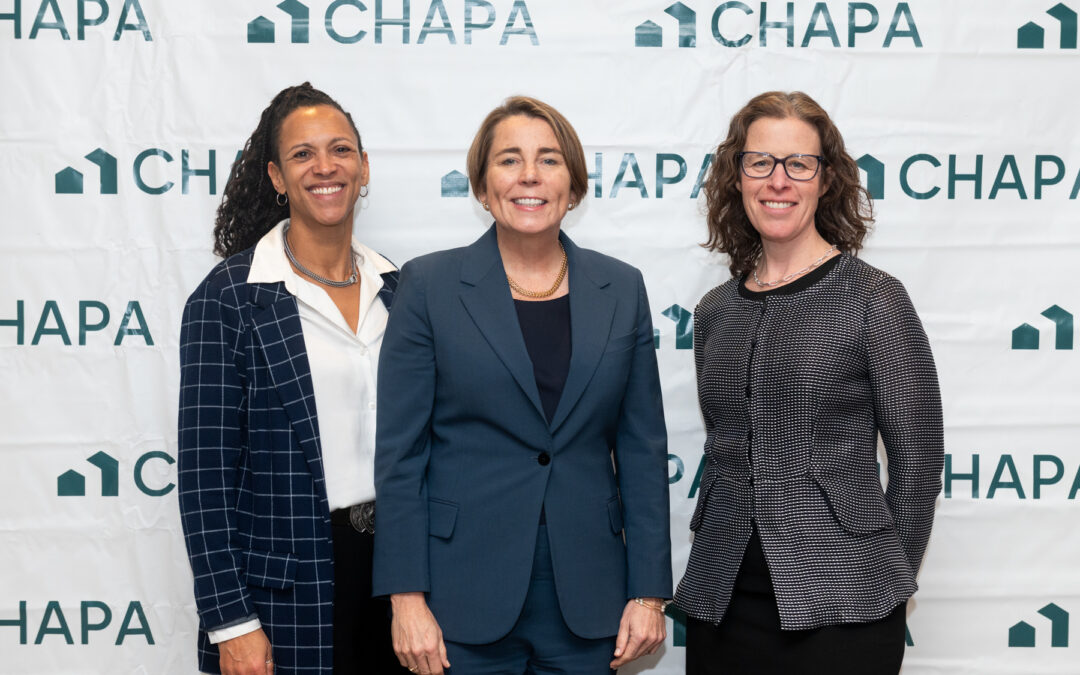
Over 400 housing leaders from across the Commonwealth, including Governor Maura Healey, Lieutenant Governor Kim Driscoll, and Executive Office of Housing and Livable Communities Secretary Ed Augustus, convened yesterday to shape how the Commonwealth can boost our housing production and meet the state’s goal of 222,000 homes by 2035. Hosted by Citizens’ Housing and Planning Association (CHAPA), the Housing Summit featured experts in modular housing, infrastructure, and climate innovation who presented creative solutions to meet the Commonwealth’s housing shortage.
“It was inspiring to join so many thoughtful and committed leaders at the CHAPA Summit who have been strong partners in our efforts to make housing more affordable across Massachusetts,” said Governor Maura Healey. “With CHAPA’s support, we’ve made significant progress — passing the Affordable Homes Act, legalizing ADUs by right, creating an Office of Fair Housing and setting the first ever statewide housing production goal. Thanks to this work, we have nearly 100,000 housing starts already underway and we’re going to continue our partnership to build more housing and lower costs for the people of Massachusetts.”
The Summit opened with a panel led by Secretary Augustus and his colleagues from across sectors: Commissioner Adam Baacke, DCAMM Undersecretary for Environment Stephanie Cooper, Undersecretary of Labor Josh Cutler, and Chief Melissa Hoffer. The panel explored how the Commonwealth can work together as a state to meet Massachusetts’ housing goals. Senator Julian Cyr and Representative Andy Vargas gave opening remarks after the panel.
“The Healey-Driscoll Administration knows that we need to accelerate housing production right now to bring down costs and provide relief to renters and homeowners navigating the tight housing market,” said Ed Augustus, Secretary of Housing and Livable Communities. “As we look to what’s next for housing in Massachusetts, we are grateful to CHAPA and today’s summit for convening the best minds in housing policy to brainstorm new solutions and deliver impact.”
Other topics explored during the event included exploring how strategic land reuse, such as the Yes in God’s Backyard (YIGBY) legislation, can dramatically increase housing capacity across the Commonwealth, using innovative construction methods, such as Mass timber, to build sustainable housing faster, and finally how developers will obtain the capital and train the workforce to build the housing needed in communities across the state. Visit the Housing Summit website for the full event agenda with panel topics and speakers.
Building on the lessons learned from the Summit, CHAPA will lead efforts to turn insights into action, creating tangible outcomes that help thousands of Massachusetts residents gain and maintain stable housing.
Summit attendees also heard from experts from Nectar Community Investments, Reframe Systems, Way Finders, Metropolitan Area Planning Council (MAPC), Massachusetts Housing Partnership (MHP), Devens Enterprise Commission, BLD Properties, Northern Middlesex Council of Governments (NMCOG), Community Economic Development Assistance Corporation (CEDAC), Boston Communities, Mass Cultural Council, The Lynch Foundation, the Office of Real Estate Management Division of Capital Asset Management & Maintenance (DCAMM), Father Bill’s & MainSpring, ISC Massachusetts, Boston Housing Authority, Beacon Communities, Allston Brighton Community Development Corporation, Massachusetts Community Climate Bank, Causeway Development, National Housing Crisis Task Force, CREA, State Street, MassHousing, Massachusetts Housing Investment Corporation (MHIC), ICON Architecture, City of Boston, Massachusetts Clean Energy Center, Preservation of Affordable Housing (POAH), Stantec, National Development, Massachusetts Department of Environmental Protection (MassDEP), Harvard University, Graduate School of Design, Capstone Communities, WoodWorks – Wood Products Council, Monte French Design Studio, Code Red Consultants, Leggat McCall Properties LLC, NEI General Contracting, MassINC Policy Center, Just A Start, and Massachusetts American Federation of Labor and Congress of Industrial Organizations (AFL-CIO).