
by Jacob Love | Oct 15, 2026 | Featured News, Housing News
Federal regulators recently proposed changes to their rules implementing the Community Reinvestment Act (“CRA”). As CHAPA reported when the proposal came out, the CRA is a critical law that prevents lending discrimination and encourages banks to invest in low- and moderate-income (“LMI”) communities.
The CRA and Affordable Housing
The CRA requires regulators to grade banks on their LMI community investment efforts and, crucially, to consider those grades when banks seek permission to expand. This incentive structure has become increasingly key for funding affordable housing development over the years.
For example, the current rules are responsible for driving 80% of private investment in the federal Low-Income Housing Tax Credit Program (“LIHTC”), which, in turn, is the “primary tool for building and preserving affordable housing” in the U.S. That puts the CRA at the center of ongoing efforts to address our nationwide affordable housing shortage.
LMI communities, especially extremely low-income households, are the hardest hit by that shortage. Thus, for the CRA to truly support those communities as intended, it must maintain strong incentives for banks to invest in affordable housing and boost our low-income housing stock.
Opposition to Proposed Changes
The proposed changes would instead do the opposite. As CHAPA outlined in a public comment opposing the proposal, the changes would:
- Weaken existing incentives for many banks to finance affordable housing; and
- Restrict the flow of flexible financial support for community development corporations.
The result will be fewer private resources available to support affordable housing development and, ultimately, fewer projects getting done. In the midst of the affordability crisis, the government should be encouraging more housing investment, not less. That is why CHAPA is calling on the federal government to reverse course and rescind the changes.
The public comment period on this proposal closed on 10/13. Under federal law, the government must now review and respond to comments before it can implement the changes.

by Jacob Love | Oct 14, 2026 | Featured News, Housing News
The Executive Office of Housing and Livable Communities (“EOHLC”) recently sought public comment on proposed changes to its rules governing accessory dwelling units (“ADUs”) in Massachusetts.
These rules, which HLC first adopted in 2025, seek to ensure that homeowners across the Commonwealth can exercise their legal right to build ADUs on residentially zoned land. Achieving that goal is key because increasing ADU supply is a straightforward way to expand lower-cost housing options.
With that in mind, CHAPA submitted a public comment on HLC’s proposal last week. We broadly support the proposed changes because many of them: (1) give homeowners greater flexibility to design ADU projects that meet their individual needs; and (2) set clearer limits on municipal ADU restrictions. Some of the most important changes for protected use ADUs include:
- Adjusting gross floor area rules to boost size allowance and dwelling space;
- Preventing localities from exceeding state/federal regulations in some areas;
- Prohibiting mandates for unneeded + expensive utility/septic configurations;
- Requiring site plan review rules for ADUs to be written;
- Listing “accessory structures” that set a lenient dimensional floor for ADUs;
- Specifying the kinds of local fees that are off limits in the ADU context.
Additionally, CHAPA supports a new provision allowing municipalities to impose affordable housing restrictions on ADUs where they provide financial assistance or donate land for a project. This launches a new tool to create affordable housing that we badly need. And limiting the tool to these narrow situations strikes a good balance between promoting affordability and preserving the ADU use protection.
The public comment period closed on 10/9. HLC must now review and consider recommendations from the public comments before it can implement any final changes.

by Jenna Connolly | Sep 21, 2026 | Featured News, Housing News
In a critical victory for housing justice and affordability, the Massachusetts Supreme Judicial Court (SJC) has upheld the legality of the MBTA Communities Act and decisively dismissed the Town of Marshfield’s legal challenge. The ruling confirms once again that compliance with the state’s affordable housing law is non-negotiable and deals a decisive blow to attempts to undermine state mandates that expand access to housing.
The SJC held that the MBTA Communities Act does not violate the Home Rule Amendment of the Massachusetts Constitution and that Marshfield failed to show the Act is an unfunded mandate. This decision marks the second high-profile case in which the state’s highest court has unequivocally declared that the MBTA Communities Act is a valid exercise of the state Legislature’s power. Citizens’ Housing and Planning Association (CHAPA), Lawyers for Civil Rights (LCR), and Nixon Peabody LLP celebrate the ruling as another landmark victory in the mission to create more affordable housing opportunities across Massachusetts.
In February, CHAPA, LCR, and Nixon Peabody filed an amicus brief with the SJC on behalf of 18 housing and civil rights organizations in defense of the MBTA Communities Act.
“Today’s decision allows communities to keep moving forward by creating more homes, stronger communities, and a thriving Commonwealth,” said Eric Shupin, Chief Executive Officer of Citizens’ Housing and Planning Association (CHAPA). “The Governor, the Attorney General, 168 MBTA Communities already in compliance, and the SJC have now all made clear that noncompliance is non-negotiable. CHAPA will continue to support using all the tools our state has, including the MBTA Communities Act, so everyone can find a safe, affordable home in the communities they choose. This is a victory for housing and opportunity across Massachusetts.”
Last year, a Superior Court judge issued a comprehensive decision dismissing unfunded mandate suits brought by Marshfield and other municipalities. In that opinion and the one issued today, the courts declined to follow the state auditor’s 2025 finding that the Act is an unfunded mandate.
“This decision affirms, once again, that the MBTA Communities Act is the law of the land in Massachusetts,” said Jacob Love, General Counsel for Policy at CHAPA. “We’re hopeful that today’s victory shuts the door on further legal challenges to the Act, so that the Commonwealth can continue to create the homes that Massachusetts residents need.”
“As today’s decision confirms, compliance with the MBTA Communities Act is, and always has been, mandatory,” said Jillian Lenson, Senior Attorney at Lawyers for Civil Rights. “Massachusetts’ lack of sufficient affordable housing for families is a crisis—and one that disproportionately impacts communities of color. It is well past time for all MBTA Communities to allow for critical multi-family development. This is now settled law, and compliance must continue to ensure greater access to housing.”
Signed into law in 2021, the MBTA Communities Act requires all municipalities served by the MBTA to designate an area where property owners can legally build apartments, townhomes, and other types of mid-scale multifamily housing. As of September 2026, over 10,000 new homes (with over 1,800 of them deed-restricted) have entered the pipeline in zoning districts adopted to comply with the MBTA Communities Act, providing potentially thousands of people—families, young adults, downsizing seniors, and more—with opportunities to find homes that fit their needs in Massachusetts.
###
Citizens’ Housing & Planning Association (CHAPA) is the leading statewide affordable housing policy organization in Massachusetts. Established in 1967, CHAPA advocates for increased opportunity and expanded access to housing so every person in Massachusetts can have a safe, affordable, and welcoming place to call home in the communities they choose. For more information, visit www.chapa.org.
Lawyers for Civil Rights (LCR) works with people of color, immigrants, and low-income communities to fight discrimination, foster equity, and pursue justice through creative and courageous legal advocacy, education, and economic empowerment. In partnership with law firms and community allies, LCR provides free, life-changing legal support to individuals, families, and small businesses. For more information, visit https://lawyersforcivilrights.org/.
Nixon Peabody LLP is an American Lawyer top-100 law firm in the United States and has offices worldwide. Our firm delivers exceptional service to our clients and our communities by combining high performance, entrepreneurial spirit, deep engagement, and an unwavering commitment to a culture of collaboration and humanity. Learn more at www.nixonpeabody.com.

by Jacob Love | Aug 18, 2026 | Featured News, Housing News
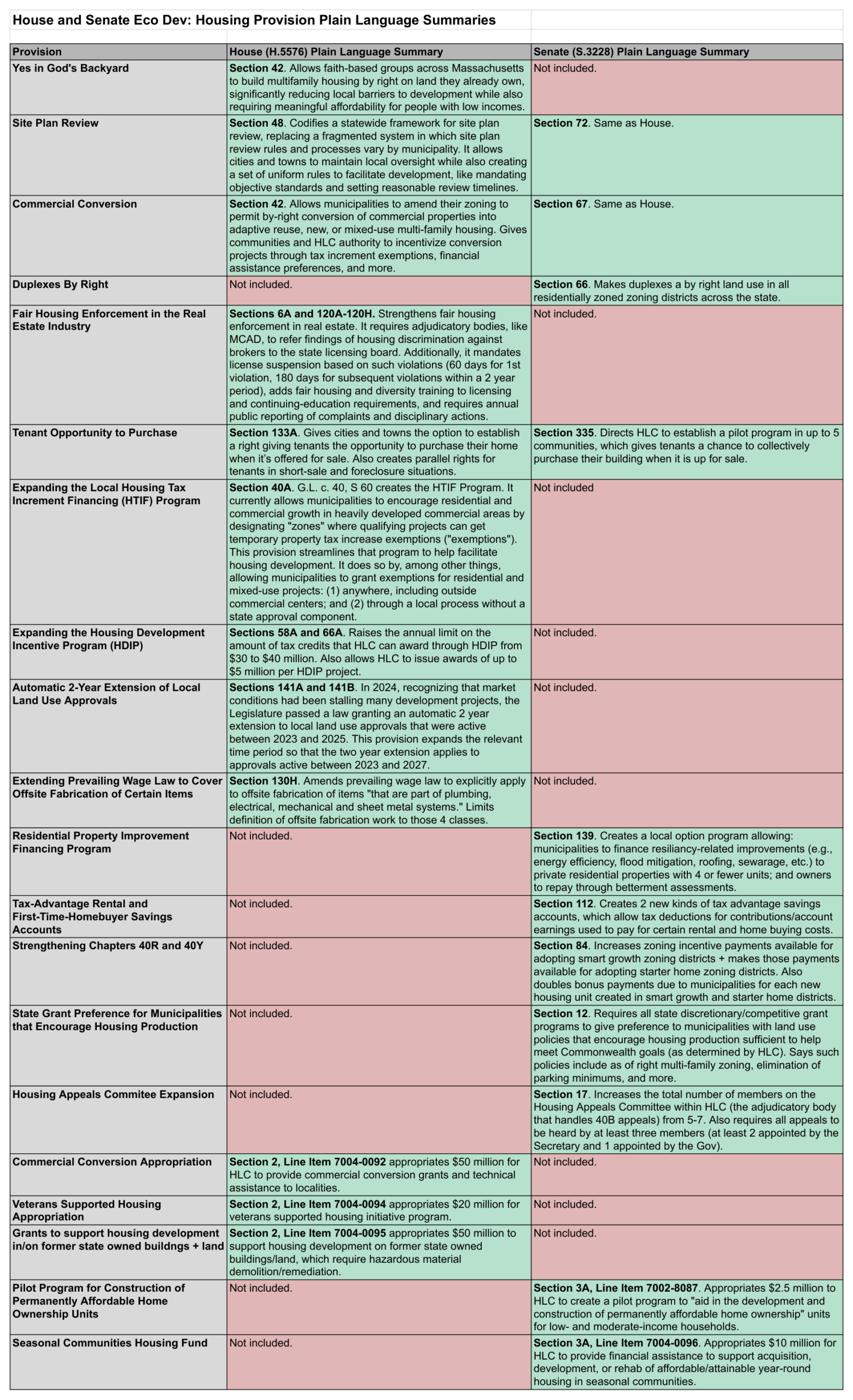
The Massachusetts House and Senate have now passed separate versions of the 2026 Economic Development Bill, sending those versions to a Conference Committee that will negotiate a single, final Bill.
Each version of the Bill currently before the Conference Committee includes a different set of housing provisions. To help legislators, advocates, and the public parse the housing policies under consideration at this stage, CHAPA has prepared a side-by-side comparison chart with summaries of the housing items contained in each version of the Bill:
by Jacob Love | Aug 3, 2026 | Featured News, Housing News
Under a 1977 law called the Community Reinvestment Act (“CRA”), federal regulators must regularly grade FDIC-insured banks on their efforts to invest in low-income neighborhoods within their service areas. The CRA also requires regulators to consider these grades when banks seek federal permission to open new branches and merge with other banks.
This is a critical mechanism not only for preventing modern lending discrimination, but also for combatting the long-term effects of historical redlining. Since poor CRA grades can hinder banks as they strive to expand, the CRA directly incentivizes private financial institutions to extend credit to historically underserved communities. As a result, the law generates hundreds of billions of dollars in annual lending for community development projects, like affordable housing, in low-income areas.
While the CRA applies to all FDIC-insured banks, it subjects them to three different levels of review based on size. Under current rules, the so-called “large bank” review process, which is by far the most rigorous, applies to institutions with more than $1.6 billion in assets. Over 500 total banks meet that threshold.
However, the federal government is now proposing to drastically shrink the total number of banks subject to each of the two highest levels of CRA review. According to reporting, if the rule is allowed to take effect, 800 total banks would drop to a lower compliance tier and only 86 total banks across the country—those with over $10 billion in assets—would be considered large banks.
Removing strict CRA oversight for hundreds of big banks will weaken their incentive to finance community development, significantly reducing the flow of funding to critical housing and revitalization projects in underserved neighborhoods across the country.
For more information, see the National Community Reinvestment Coalition’s resource on the proposal.
by Jacob Love | Jul 10, 2026 | Featured News, Housing News
Governor Maura Healey signed the FY2027 budget this week, approving the version the Legislature sent to her desk without any vetoes. CHAPA advocated for that outcome to preserve key housing priorities contained in the $63.4 billion appropriations package. And we thank both the Governor and the Legislature for their continued work to preserve and expand critical housing programs, even in a very difficult budget year.
This year’s budget increases funding for key state rental assistance and supportive housing initiatives like MRVP, Public Housing, RAFT, and HomeBASE, and maintains level funding for many other beneficial efforts such as first time home buyer counselling. Additionally, the outside sections codify several targeted changes to Chapter 40A, the Commonwealth’s Zoning Act, designed to reduce local obstacles to development and expand housing production. A separate outside section streamlines the disposition of vacant public housing, helping housing authorities more quickly clear and repurpose long-vacant units so they can be returned to safe use for residents who need them.
CHAPA published a detailed analysis of the housing pieces in this budget earlier this month, which you can find here. We have also produced a budget tracker, which provides a side-by-side housing comparison between this year’s budget and last year’s.