by iwd Tina | Feb 13, 2024 | Housing News
Four leading statewide affordable housing organizations today called on Milton residents to vote YES on February 13 to adopt multi-family zoning consistent with the MBTA Communities Law.
“A YES vote in Milton will show that inclusive zoning is part of an overall strategy to preserve what we love about our unique neighborhoods, expand affordable housing, grow our local economies, and make it easier for people to get around without always needing to drive,” said Rachel Heller, CEO of Citizens Housing and Planning Association. “Housing is the best investment we can make for a strong future.”
Two-thirds of town meeting members voted to approve the zoning article in December but a group of opponents have collected signatures to put the issue to a town-wide vote on February 13th.
“Milton prides itself on its suburban diversity,” said Symone Crawford, executive director of the Massachusetts Affordable Housing Alliance. “With the average single family home in Milton now selling for over $1 million, A YES vote is one way to ensure that diversity continues.”
“State officials are serious about cutting off access to discretionary grants and state aid,” said Jesse Kanson-Benanav, executive director of Abundant Housing Massachusetts. “Milton voters can avoid that risk by saying YES on February 13 and create more housing choice for its residents.”
State law calls for the 177 communities in greater Boston served by the MBTA to adopt multi-family zoning districts. Twelve communities, those closest to Boston and served by rapid transit, faced the first deadline for compliance of December 31, 2023. All twelve adopted compliant zoning by that date. Milton is the only one of the twelve contesting that adoption.
“Local nonprofit affordable housing developers have created thousands of affordable homes over the years but the need for more is obvious,” said Emily Haber, President and CEO of the Massachusetts Association of Community Development Corporations. “If you care about creating more affordable homes, a YES vote on February 13th is the only vote.”
“A yes vote will move Milton forward,” said Matt Morong, co-chair of YES! for Milton. “Our town planners and town residents spent eighteen months devising a plan to comply with this 2021 state law which is designed to take some pressure off of our housing market. Milton needs to be part of our regional housing solution.”
by iwd Tina | Feb 6, 2024 | Housing News
Right now, members of Congress are working to pass fiscal year 2024 spending bills for a range of federal agencies, including the Department of Housing and Urban Development (HUD). Unfortunately, there are indications that the proposals being considered would underfund HUD and threaten housing and homelessness programs.
From the National Low Income Housing Coalition (NLIHC):
Congress needs to hear from you! Advocates should contact their members of Congress and demand they help address the housing and homelessness crisis by enacting an FY24 spending bill with significant increases for affordable housing and homelessness programs, including NLIHC’s top priorities:
- Full funding to renew all existing contracts for the Housing Choice Voucher (HCV) program.
- Increased funding for public housing operations and repairs.
- At minimum, the $3.9 billion for Homeless Assistance Grants proposed by the Senate bill.
- The protection of $20 million in funding for the Eviction Prevention Grant Program provided in the Senate bill.
- The $1.1 billion for Native Housing proposed by the House bill.
Advocates can continue to engage their members of Congress by:
- Emailing or calling members’ offices to tell them about the importance of affordable housing, homelessness, and community development resources to you, your family, your community, or your work. You can use NLIHC’s Take Action page to look up your member offices or call/send an email directly!
- Using social media to amplify messages about the country’s affordable housing and homelessness crisis and the continued need for long-term solutions.
- Sharing stories of those directly impacted by homelessness and housing instability. Storytelling adds emotional weight to your message and can help lawmakers see how their policy decisions impact actual people. Learn about how to tell compelling stories with this resource.
National, state, local, tribal, and territorial organizations can also join over 2,100 organizations on the Campaign for Housing and Community Development Funding’s (CHCDF’s) national letter calling on Congress to support the highest level of funding possible for affordable housing, homelessness, and community development resources in FY24
by iwd Tina | Feb 5, 2024 | Housing News
On January 31, the House of Representatives passed HR 7024, the Tax Relief for American Families and Workers Act of 2024 by a vote of 357-70. Among the many provisions of the bill are housing tax credits: the restoration of the 12.5 percent allocation increase for 2023-2025 and the reduction of the bond threshold required to access the 4 percent credit from 50 percent to 30 percent for 2024 – 2025.
This bill now moves on to the Senate where party leaders will negotiate to put the bill to a vote. The legislation will need 60 votes to avoid procedural hurdles and could be delayed if it is sent to the Finance Committee to be marked up instead of directly to the Senate floor.
National housing advocates are urging anyone supporting this bill, and the housing credits it includes, to contact their senators and urge them to bring it to a vote soon. For more on this legislation and advocacy opportunities, visit the Housing Advisory Group’s website.
by iwd Tina | Jan 24, 2024 | Housing News
by iwd Tina | Jan 24, 2024 | Housing News
On January 24th, Governor Healey revealed the FY2025 budget proposal of $56.1 billion for the upcoming fiscal year, focusing on investments in education, infrastructure, and housing.
Revenue & Budget:
This budget represents an increase of 2.9% from the previous fiscal year (FY24), reflecting restrained revenue growth. The $56.1 billion budget allocates full funding for the Student Opportunity Act, boosts local aid, and covers the costs of tax reductions implemented last year. It includes an anticipated $1.3 billion in revenue from the Fair Share surtax, which is earmarked for education and transportation initiatives.
To manage the gap between revenue and spending, the budget trims $450 million from various items and avoids $500 million in additional spending. The Rainy Day Fund is expected to receive a $97 million deposit. For more information on the revenue estimates and budget rationale, check out the FY2025 Budget briefs by the Administration.
Affordable Housing Priorities:
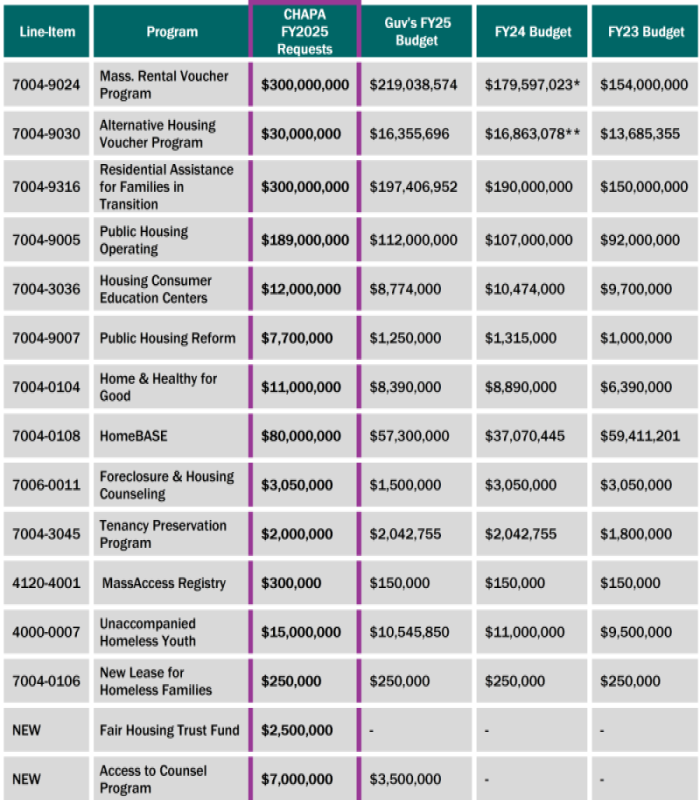
Many of CHAPA’s affordable housing priorities received an increased investment in the Governor’s FY2025 budget proposal while many others received a level of funding and some of them had lower allocations than FY2024. Please see our Language analysis of the affordable housing priorities for policy details.
Supplemental Budget
Along with the FY2025 budget, the Administration also filed a Supplemental budget that draws from the transitional escrow funds to cover the EA shelter costs for FY2024 and FY2025. The Supp budget proposes $70 million for the Housing Stabilization Fund to provide for acquisition, preservation, rehab, and homelessness prevention; $50 million for Public Housing; $20 million for the Housing Innovation Fund, and $10 million for the Momentum Fund.
by iwd Tina | Jan 23, 2024 | Housing News
On January 22nd, the Healey-Driscoll Administration announced investments in affordable housing for the production and preservation of over 1,900 housing units in 19 communities. This involves the allocation of state funding and Low-Income Housing Tax Credit (LIHTC) support for various projects.
The Legislature and the Administration passed a $1 billion tax relief bill in the fall of 2022, which included raising the Low-Income Housing Tax Credit to $60 million annually – a $20 million increase over the previous year.
The projects receiving the investments encompass a diverse range of developments, such as transforming a historic church into mixed-use housing in Boston and repurposing a vacant nursing home in Northampton.
The projects include:
- Residences at the Park – Athol
- 135 Dudley Street – Boston
- 775 Huntington – Boston
- Blessed Sacrament – Boston
- Mildred Hailey 3 – Boston
- NUBA Apartments – Boston
- Thatcher Apartments – Brockton
- Clifton Place – Cambridge
- Jackson Place – Cambridge
- Sacred Heart – Cambridge
- 4th at Broadway – Chelsea
- 25 Garvey Street – Everett
- Franklin Ridge Senior Housing – Franklin
- Library Commons 2 – Holyoke
- Prospect Place – Northampton
- Southern Tier – Oak Bluffs
- Schoolhouse Apartments – Rockland
- The Exchange 4%/9% – Salem
- 24 Webster Avenue – Somerville
- Plaza Apartments – South Hadley
- Residences at the Vault – Springfield
- Baldwinville School – Templeton
- Residences at Lawrence Hill – Wellfleet
- WCG Homes – Worcester
- Solimine House, Lynn (150 affordable senior housing units with health care supports)
- 900 Morrissey Boulevard, Boston (99 single-room occupancy units, with extensive support services, to chronically homeless individuals in a now-vacant hotel)
For more on the Administration’s press release, please visit https://www.mass.gov/news/healey-driscoll-administration-announces-new-affordable-housing-development-across-the-state.
by iwd Tina | Jan 23, 2024 | Housing News
On January 8th, the Healey Administration announced a revision to the current fiscal year’s budget called 9C cuts, which involves a $375 million reduction due to lower-than-expected tax collections. The Administration projected a $1 billion decrease in tax revenue for this budget year which may also impact the FY2025 budget.
The term ‘9C cuts’ refers to the Massachusetts Governor’s authority, under Section 9C of Chapter 29 of the General Laws, to unilaterally reduce state spending when tax revenues fall short of projections to ensure a balanced budget without legislative intervention.
The most notable change to CHAPA priorities was a $5 million cut in funding for Housing Consumer Education Centers, under line item 7004-3036. However, this decrease will be effectively neutralized by additional funds from the Federal Moving to Work program, ensuring that the Housing Consumer Education Centers will continue to receive the same allocation. Alongside this, other areas such as cash assistance programs (TAFDC) and Senior Supportive Housing programs also saw reductions in their budgets. Please refer to this chart for a full list of budget cuts.
The Administration’s strategy involves reducing expenditures for the next six months, utilizing typically non-budgeted investment earnings, and aiming for minimal revenue growth in the coming year. This approach, according to Healey’s team, is designed to navigate through fiscal year 2024 without further cuts, setting the stage for a balanced budget in fiscal year 2025, for which the proposal is due by January 24.
by iwd Tina | Nov 16, 2023 | Housing News
Currently, Massachusetts’ emergency shelters are at capacity due to a prolonged housing crisis compounded by a pressing humanitarian issue with many individuals and families fleeing their home countries due to conflict, persecution, or economic hardship. CHAPA is working with the Massachusetts Coalition for Homeless (MCH) and the Massachusetts Law Reform Institute (MLRI) to advocate for the preservation and protection of our family shelter system, and to provide safe and affordable housing for every family in Emergency Assistance shelter.
We have jointly issued a letter of recommendation with MCH & MLRI to the Administration and Legislature asking for the following:
- Expanding available services for newly-arrived immigrant families and improving service coordination for all families experiencing homelessness
- Helping families swiftly move out of Emergency Assistance and other temporary shelter programs into permanent affordable housing
- Strengthening homelessness prevention resources to ensure that more families and individuals can maintain housing stability.
According to the Administration, the shelter capacity has reached 7,500 shelter units and the shelter system may not have enough space to shelter every eligible family right away. Families seeking shelter will be on a waitlist and will be moved to shelter as space opens up. For more details on the waitlist, please visit the Administration’s page on waitlists.
by iwd Tina | Nov 16, 2023 | Housing News
The House passed a $2.74 billion FY2023 Closeout Supplemental budget (H. 4167) which includes an allocation of $250 million for the emergency shelter system on November 8th. The Administration had requested the $250 million for the emergency shelter system in September in their supplemental budget proposal. The House version lays out specific directions on how that money could be spent.
On November 15th, the Senate passed their version of the $2.8 billion Supplemental budget (S.2502), including the the allocation of $250 million for the emergency shelter system. The language in the Senate bill, however, does not require targeted spending allotments within the total allocation, as the House proposes, but does require the administration to report on the spending every two weeks.
The last day of formal legislative sessions were on November 15th. The House and Senate appointed a Conference Committee to reconcile the differences in the two versions. The House and Senate will now have to vote on the bill in informal sessions or wait until January when formal sessions resume.
CHAPA thanks the Legislature for including the $250 million for emergency shelter in the Supplemental budget versions. We also urge the Legislature to reconcile the differences and pass the bill quickly so that families seeking shelter have a safe place to stay.
by iwd Tina | Oct 25, 2023 | Housing News
Citizens Housing and Planning Association (CHAPA) applauds the Healey-Driscoll Administration for their historic proposal to invest $4 billion in affordable housing. The Affordable Homes Act is more than a housing plan; it is a statement of values.
Housing is the single best investment we can make for the future of Massachusetts. Governor Healey’s proposal builds on the new MBTA Communities Multifamily Zoning Law and the Housing Choice Act, to create affordable housing as communities put zoning in place for the 200,000 homes Massachusetts needs to stabilize home prices and rents. The Affordable Homes Act moves us forward in building 40,000 homes that are affordable for households with moderate incomes and 20,000 homes that are affordable for people with low and extremely low incomes. Creating homes for people across income levels will ensure that people, our communities, our economy, and our Commonwealth thrive.
The Affordable Homes Act proposes significant increases in funding for affordability, equity, and choice. This bill will create and preserve affordable and supportive housing, increase the supply of homeownership opportunities; invest in preservation, decarbonization, and redevelopment of public housing; increase accessibility for people with disabilities, expand housing diversity by allowing accessory dwelling units and investing in a social housing pilot program, expand tenant protections and long term housing stability; enable communities to establish real estate transfer fees to fund affordable housing production, and make it easier for communities to require affordability as part of multifamily development. The Affordable Homes Act invests in our neighborhoods through support for community development corporations and financing the construction and renovation of early education centers that serve families with low incomes.
The Affordable Homes Act makes great strides towards a more equitable Massachusetts. Through the creation of the Office of Fair Housing, the state will support communities and state agencies to further fair housing so that all communities are invested in and people have meaningful choices in where they live. Investments in CommonWealth Builder, MassDREAMS, and the creation of the Homeownership Production Tax Credit will increase the supply of homeownership opportunities and effectively narrow the racial homeownership gap by supporting people who have been kept out and left out of homeownership opportunities to achieve their homeownership goals.
The Affordable Homes Act will keep the state moving forward, building on the Commonwealth’s legacy of investing in affordable housing. New tools will expand the supply of deeply affordable homes so that shelters are a temporary place for people to be safe as they get the support they need to move into homes they can afford. By establishing a commission on senior housing and housing for people with extremely low incomes, creating a state housing plan, making receivership reforms, developing a seasonal designation for communities with tourism economies to meet their short and long-term housing needs, and creating a supportive housing pool fund to fund the services and coordination not funded through other sources, the Commonwealth will continue the work to develop policies and programs that will put Massachusetts on the path to a bright future where everyone can thrive.
CHAPA looks forward to working closely with members of the House and Senate as well as stakeholders from across the Commonwealth over the next several months to craft a final bill that will ensure that every Massachusetts has access to a safe, affordable home in the community they choose. We invite our members, partners, and affordable housing supporters to join us in advocacy to get the final bill across the finish line.