by iwd Tina | Apr 1, 2022 | Housing News
On April 1, Governor Baker signed a supplemental state budget for FY2022 that $100 million in additional funding for emergency rental assistance through the RAFT program. The budget also extends renter protections through March 31, 2023, that pauses eviction cases for tenants who have a pending application for emergency rental assistance.
by iwd Tina | Mar 31, 2022 | Housing News
CHAPA’s Comments on Draft Guidelines for MBTA Communities submitted to the Executive Office of Housing and Economic Development on March 31, 2022.
Dear Secretary Kennealy,
On behalf of Citizens’ Housing and Planning Association (CHAPA), I am writing to share CHAPA’s comments on the draft guidelines to implement Section 3A of M.G.L. Chapter 40A, the state’s Zoning Law.[1]
CHAPA is pleased that the draft guidelines meet this historic moment by creating a path forward for producing the 200,000 homes the Commonwealth needs by 2030 and allowing for continued growth to meet our needs in the future. The draft guidelines prioritize the creation of new homes close to public transportation and ensure communities make decisions about where they will guide development. The draft guidelines also emphasize equity and fair housing by providing more choice through a diversity of housing types while requiring new housing to be suitable for families with children. These principles are critical to meet growing demand and plan for the homes we need at all income levels so that every community can prosper.
CHAPA respectfully submits the following comments to help ensure that the final guidelines remain as strong as possible for creating new opportunities for everyone to have an affordable home in the community they choose.
Prioritizing Affordable Housing
CHAPA asks that the final guidelines be amended to prioritize and emphasize housing affordability. CHAPA recognizes that zoning remains a key barrier to creating affordable housing. Section 3A will open up the opportunity for more affordable housing development by creating zoning in communities to allow multifamily housing as of right. However, the guidelines should be amended to state that housing affordability is a priority and to make it easier for MBTA communities to both comply with Section 3A and create affordable housing.
The Governor signed Section 3A into law to produce new, high-density, mixed-income housing near public transportation.[2] The guidelines should explicitly include this goal to create housing affordable across all incomes. In order to achieve this, CHAPA suggests that language be added to Section 3 of the guidelines, General Principles of Compliance. Specifically, the first bullet under Section 3(b) should be amended to:
- “All MBTA communities should contribute to the production of new, mixed-income housing stock.”
The third bullet under this same section should also be amended to:
- “MBTA communities should adopt multi-family districts that will lead to development of multi-family housing projects of a scale, density, character, and affordability that are consistent with a community’s long-term planning goals.”
This added language acknowledges that MBTA communities should take into consideration the creation of affordable and mixed-income housing when implementing the requirements of Section 3A.
The guidelines should also be amended to explicitly state that 40R affordable overlay districts will meet the requirements of Section 3A. Massachusetts is fortunate to have Chapter 40R as an existing zoning tool for MBTA communities to use that complies with Section 3A, provides additional resources to communities and their schools, and increases our supply of affordable housing.[3]
Many of the provisions of Section 3A parallel Chapter 40R. For example, 40R overlay districts must meet certain smart growth characteristics, including as of right densities of at least 20 units per acre for multifamily housing, and location requirements for the district to be, in most cases, within a ½ mile of a transit station.
Recognizing that a 40R district of the appropriate size will allow an MBTA community to comply with Section 3A would provide certainty and resources to these communities. Specifically, CHAPA suggests amending the guidelines in the first sentence of the second paragraph of Section 5(a) to: “An overlay district, including an overlay district for multifamily housing created under Chapter 40R, is an acceptable way to achieve compliance with Section 3A…”
Technical Assistance offered to communities to help implement Section 3A should also include information on all available tools and resources available to create affordable housing in these multifamily districts. For example, communities should be encouraged to adopt inclusionary zoning bylaws in order to ensure that some portion of any new multifamily housing created in these districts includes affordable housing. Technical assistance could include model inclusionary zoning bylaws and support drafting an inclusionary bylaw that meets the unique needs of each community.
Massachusetts has a variety of existing resources and funds that can help create affordable housing in these new zoning districts. These include, but are not limited to: American Rescue Plan Act Fiscal Recovery Funds; locally controlled funds from the Community Preservation Act or municipal affordable housing trusts; Chapter 40R; and capital resources dedicated to creating transit-oriented affordable housing. Information on these resources should also be provided to communities as they implement Section 3A.
Ensuring Compliance
CHAPA asks that the guidelines be amended to reflect that all MBTA communities must comply with Section 3A and that compliance is not optional.
As the law states, “An MBTA community shall have a zoning ordinance or by-law that provides for at least 1 district of reasonable size in which multi-family housing is permitted as of right…”[4] As the Department of Housing and Community Development (DHCD) recognizes, “the word ‘shall’ indicates that the legislature intended to require all MBTA communities to have a multi-family zoning district.”[5]
In order to achieve this, CHAPA asks that the third paragraph in Section 1 of the guidelines be amended to, “The purpose of Section 3A is to require encourage MBTA communities to adopt zoning districts where multi-family zoning is permitted as of right, and that meet other requirements set forth in the statute.”
Also, CHAPA asks that the third bullet in Section 3(b) of the guidelines be amended to:
- “MBTA communities shall
should adopt multi-family districts that will lead to development of multi-family housing projects…”
The guidelines should also include that a potential effect of noncompliance may extend further beyond not being eligible for certain state grants and that a community could become subject to other legal liability. Specifically, CHAPA asks that Section 11 of the guidelines be amended to add, “Section 3A indicates that the legislature intended to require all MBTA communities to have a multi-family zoning district. Failure to comply may result in other legal liability.”
CHAPA also asks that the guidelines be strengthened regarding the Governor’s authority to withhold other state discretionary awards based on the compliance of an MBTA community with Section 3A. CHAPA appreciates that DHCD includes in the guidelines that DHCD may, in its discretion, take non-compliance into consideration when making other discretionary grant awards. However, these other grant awards should not be limited to only those administered by DHCD.
All state infrastructure and development-related funding should be prioritized for communities that zone for multifamily housing and that have effective inclusionary zoning in place, invest in affordable housing, establish 40R districts, or have additional policies in place that support long term affordable housing.
Under an existing Executive Order, the Governor has the authority to consider a city’s or town’s housing policies and practices when distributing development-related discretionary awards.[6] According to Executive Order 215, “It should be the general policy of all state agencies not to award discretionary funds to cities or towns which have been determined to be unreasonably restrictive of new housing growth.”
CHAPA asks that Section 11 of the guidelines be amended to include a reference to Executive Order 215 and to expand the list of state discretionary grants that an MBTA community may become ineligible for if it does not comply with Section 3A.
CHAPA suggests the following change to the last sentence of Section 11:
“Under Executive Order 215, all state agencies DHCD may, in their its discretion, take non-compliance into consideration when making other discretionary grant awards for development related assistance. Development related assistance may include, but is not limited to: economic development assistance; open space and recreation funds; technical assistance grants; municipal access improvements; transportation improvements; conservation land grants; elderly housing; sewer and water system grants; parking facility funds; convention center facility grants; federal grant funds for development-related activities; and the review of federal grant applications for development assistance.”
Producing New Homes
CHAPA asks that the final guidelines be amended to evaluate the unit capacity of a district based on the number of new homes that could feasibly be built to determine compliance rather than allowing existing zoning capacity to lessen the impact Section 3A. While CHAPA applauds communities that have had multifamily zoning on the books for many years, our need for new homes continues to grow. Allowing already built-out districts to count toward satisfying the requirements of the new law, as described in Section 5(b) of the guidelines, would undercut efforts to ensure every community is doing its part to meet demand and provide homes for current and future residents, and result in the guidelines falling far short of the intent of 3A, which is the creation of new homes.
Achieving Housing Choice, Equity, & Fair Housing
CHAPA asks that the guidelines be amended to remind and educate MBTA communities that the new zoning districts must advance housing choice, equity, and fair housing. The Legislature passed Section 3A to increase housing choices in MBTA communities, particularly for families with children. Any new zoning should also increase equity by creating homes accessible to persons of all races, ethnicities, abilities, and incomes. Section 3A should be used to redress the racial inequity and disparate impacts of longstanding housing practices that have excluded people from many communities in the Commonwealth, including policies that continue to this day. If new zoning enacted in accordance to Section 3A does not allow for this, then housing choice has not been achieved.
MBTA communities must also follow all federal and state fair housing laws. CHAPA hopes that communities will consider how any new multifamily zoning district will further fair housing goals and avoid displacement or other negative impacts. Communities could look to Boston’s recently enacted affirmatively furthering fair housing zoning bylaw that requires an assessment of a development’s impact on the community.[7]
To help achieve this, CHAPA suggests that the guidelines be amended to add the following bullet to Section 3(b):
- “MBTA communities must adopt multi-family districts that are suitable for families with children. MBTA communities must follow all federal and state fair housing laws when implementing Section 3A in order to protect against housing discrimination and practices that disparately impact protected classes.”
Creating Truly Accessible and Transit Oriented Housing
CHAPA asks that the guidelines be strengthened to ensure that new zoning districts are not simply transit-adjacent but truly transit-oriented. The core objective of Section 3A will not be met if new districts are functionally inaccessible because of distance, unsafe infrastructure, inaccessible entry points, or lack of sidewalks or safe crossing to transit stations. Through these guidelines, DHCD should aim to create “15-minute neighborhoods” that prevent sprawling patterns of development and encourage more compact village style development.[8] Compactness is an essential element of successful transit-oriented development, enabling residents to get to nearby amenities and the transit stop, and reducing reliance on cars in all aspects of daily life.
Partnering with MBTA Communities
CHAPA asks that the guidelines be amended to explicitly include that the state recognizes its role as a partner to support MBTA communities as they implement and comply with Section 3A. We appreciate that the state, through DHCD and the Massachusetts Housing Partnership, has already begun to offer technical assistance and guidance to MBTA communities.[9]
CHAPA hopes that the state continues to develop even more robust technical assistance that may include resources like model bylaws for a compliant multifamily zoning district, best practices, fair housing training, or more specific technical assistance for communities facing specific challenges such as sewer capacity.
In order to recognize this partnership between MBTA communities and the state, CHAPA asks that the guidelines be amended to add the following bullet to Section 3(b):
- “DHCD and other state- and quasi-state agencies will, to the greatest extent possible, provide support through technical assistance for MBTA communities as they implement with Section 3A.”
Preventing Loopholes
CHAPA asks that DHCD prevents communities from using loopholes that may frustrate the purpose of Section 3A. DHCD should, in its process of determining compliance, take into consideration whether an MBTA community may have unreasonably limited its multifamily zoning district. Examples of this may include, but not be limited to: the use of conservation or historic preservation districts; resident selection preferences; siting on brownfields; unduly burdensome parking requirements; or infeasible inclusionary zoning requirements.
Clarifying Questions
CHAPA also asks that the guidelines or other information provided by DHCD be updated to include answers to clarifying questions as MBTA communities implement Section 3A. These clarifying questions include, but are not limited to:
- The definition of “bus station” and whether the following would qualify as a bus station:
- Bus depot or service facility; or
- Bus shelter along a bus line with frequent service (i.e., 3–4 times per hour) express service to Cambridge, Boston, or other job center.
- Whether senior housing can be built in these districts.
- Who determines what “adequate wastewater infrastructure” is for the purposes of designating “Developable Land”.
- What is included under the term “Discretionary permit or approval” when it comes to determining whether the zoning is truly “as of right”.
- How DHCD will analyze proposed districts for compliance and economic feasibility.
- How sustainability features can be built into a project that is in a MBTA district, and through what process.
- Additional guidance on how Site Plan Review and Site Plan Approval can be incorporated.
- Whether a community may incentivize certain types of housing (i.e., larger 3+ bedroom units or senior housing), understanding that the underlying zoning cannot restrict housing that is suitable for families with children.
- How Section 3A will interact with Historic Overlay Districts and whether a zoning district will still be considered by-right if historic review or approval is required.
Offering additional clarity around these areas will make it easier for communities to understand and comply with the new law.
Conclusion
We know what is at stake if we do not meet this moment. Housing will continue to get more expensive. More people will be priced out of the neighborhoods they love. Embracing multifamily housing protects our environment, improves our overall health, and strengthens our local economies. It gives current and future residents more choice in where they want to live while remaining connected to their networks, their jobs, and essential resources. The new state law, together with these guidelines, provides the opportunity for our communities to grow stronger and healthier.
Thank you for the opportunity to comment and for your consideration. Please do not hesitate to contact me with any questions.
As always, thank you for your leadership in helping everyone in the Commonwealth have a safe, healthy, and affordable home in a community of their choice.
Sincerely,
Rachel Heller
Chief Executive Officer
[4] M.G.L. Ch. 40A, Sec. 3A(a) (emphasis added).
by iwd Tina | Mar 24, 2022 | Housing News
On Thursday March 24th, the Massachusetts Senate will be debating the FY2022 Supplemental budget proposal (S.2776). The Senate Ways & Means proposal includes $100 million for rental assistance through the Rental Assistance for Families in Transition Program (RAFT) same as the House allocation. The budget also extends renter protections that pause eviction cases for tenants who have a pending application for emergency rental assistance. These protections, which would have ended in April 2022, will now be in place through April 2023 (the House proposed the extension until March 2023).
CHAPA supports the following amendments for the Senate debate that would help expand RAFT allocation and increases the RAFT benefit amount.
| # |
Program |
Sponsor |
Description |
| 15 |
RAFT cap to $10,000 |
Sen. Keenan |
Increases funding to $200 million |
| 16 |
RAFT |
Sen. Keenan |
Lifts the RAFT cap to $10,000 from the current $7,000 |
| 17 |
Rollover RAFT funds |
Sen. Keenan |
Allows carryover of unspent RAFT funds from FY2022 to next fiscal year
|
| 10 |
RAFT |
Sen. Gomez |
Increases funding to $200 million |
by iwd Tina | Feb 28, 2022 | Housing News
Please join CHAPA in signing a letter in support of a proposed Zero Carbon Renovation Fund to allocate $250 million of the state’s ARPA funds to rapidly renovate the Commonwealth’s existing buildings to zero carbon.
SIGN THE ZERO CARBON RENOVATION FUND LETTER
This Zero Carbon Renovation Fund, administered through the Massachusetts Clean Energy Center, will result in deep carbon savings by transforming our existing buildings to be super energy efficient, all electric, powered by clean renewable energy, and renovated with low-embodied carbon materials.
The fund would be available for affordable housing, public housing, low- and moderate-income homes, and municipal buildings. Zero carbon renovations will also help ensure that the Commonwealth’s most vulnerable populations benefit from a just transition off of fossil fuels.
For more information, visit the Mass Climate Action Network (MCAN) website where you will find the sign-on letter, the Zero Carbon Renovation Fund proposal, and the Google Form to sign on in support of this investment.
This effort is being orchestrated in collaboration with many organizations, including: LISC-Boston, MACDC, CHAPA, MAPC, RMI, Massachusetts Sierra Club, Passive House Massachusetts, Acadia Center and New Ecology.
by iwd Tina | Feb 3, 2022 | Housing News
On February 2nd, the Joint Committee on Housing, chaired by Senator Keenan and Representative Arciero, favorably reported out four of CHAPA priority bills. The following bills will likely move to the respective Senate and House Committees on Ways and Means chaired by Senator Rodrigues and Representative Michlewitz.
- An Act relative to housing production (H.1448/S.871)
Sponsors: Rep. Vargas and Rep. Honan & Sen. Crighton
This legislation will increase the production of affordable homes, remove restrictive zoning barriers, and proposes innovative solutions for land use in Massachusetts
- An Act restoring the Commonwealth’s public housing (H.1417)
Sponsors: Rep. Honan
This legislation will help restore the state’s public housing by allowing housing authorities to leverage new and additional resources for rehabilitation and redevelopment projects.
- An Act codifying the Massachusetts Rental Voucher Program (H.1428/S.898)
Sponsors: Rep. Madaro & Sen. Lovely
These bills would codify MRVP into state statute and make program improvements including reducing the tenant payment share, increasing administrative fees, requiring inspections, and improving data collection.
- An Act reducing CPA recording fees for affordable housing (H.2899)
Sponsors: Rep. Ferrante
This bill would reduce Community Preservation Act (CPA) recording fees for affordable housing in those cities and towns that have enacted the CPA.
The Joint Committee on the Judiciary favorably reported out the following CHAPA priority bill:
- An Act promoting housing opportunity & mobility through eviction sealing (HOMES) (H.1808/S.921)
Sponsors: Representative Michael Moran & Senator Joseph Boncore
This legislation will protect tenants from being unfairly branded with an eviction record if they don’t have a judgment against them, if they weren’t actually evicted, or if they didn’t do anything wrong.
The following CHAPA priorities received extensions so that the committees can continue to work on the bills:
- An Act promoting housing stability and homelessness prevention in Massachusetts (H.1436/S.874)
Sponsors: Representatives Michael Day and Dave Rogers & Senator Sal DiDomenico
Recognizing the housing emergency exacerbated by COVID-19 and the severe public health risks associated with displacement, this legislation would prevent evictions and promote housing stability during the pandemic and over the long-term. The bills provide legal representation for tenants and owner-occupants with low incomes in eviction proceedings.
- An Act promoting fair housing by preventing discrimination against affordable housing (H.1373/S.867)
Sponsors: Representative Christine Barber & Senator Sonia Chang-Díaz
Massachusetts has high levels of residential segregation. Restrictive local zoning and permitting decisions have helped create and perpetuate these patterns based on race, socioeconomic status, and familial status. These bills would prohibit municipal and state discriminatory zoning bylaws, ordinances, and land use decisions.
- An Act providing for climate change adaptation infrastructure and affordable housing investments in the Commonwealth (H.2891/S.1853)
Sponsors: Representative Nika Elugardo & Senator Jamie EldridgeMassachusetts is facing both an affordable housing crisis and a climate change crisis, unfortunately made worse by COVID-19. This legislation would double the deeds excise tax on the sale of real property and dedicate the estimated $300 million in annual revenue towards affordable housing and climate sustainability. The deeds excise tax is not only directly linked to rising real estate prices but it’s also an affordable and equitable way to generate revenue for the state of Massachusetts.
- An Act empowering cities and towns to support affordable housing with a fee on certain real estate transactions (H.1377/S.868)
Sponsors: Representative Michael Connolly & Senator Joanne Comerford
This legislation would give individual cities and towns the ability to decide for themselves whether to enact a real estate transfer fee (between 0.5%-2.0%) for the exclusive purpose of creating and supporting local affordable housing.
CHAPA’s priorities on Affirmatively Furthering Fair Housing (H.1441/S.861) and establishing a fair housing disparate impact standard (H.1854/ S.860) were sent to study and will not advance further this legislative session.
Fact sheet on CHAPA’s legislative priorities.
by iwd Tina | Jan 31, 2022 | Housing News
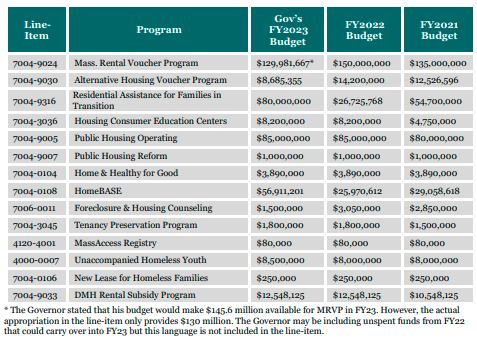
On January 26, 2022, Governor Baker released his $48.6 billion state budget for FY2023 (H.2), which begins on July 1, 2022. According to Governor Baker, the budget would promote growth and support the ongoing public health response to COVID-19 while increasing total state spending by approximately 0.5% above Fiscal Year 2022.
The proposal would add $749 million to the state’s rainy day fund which will bring the total balance of the fund to $6.64 billion by the end of FY2023. The fund currently has a balance of $4.64 billion. This budget is submitted alongside a comprehensive tax relief proposal and proposes full funding for the Student Opportunity Act.
The Governor’s proposal includes increases to priorities like RAFT, and HomeBASE with reductions for rental assistance programs including Mass. Rental Voucher Program (MRVP) and Alternative Housing Voucher Program (AHVP).
For more information on the Governor’s budget proposal for affordable housing, homelessness prevention, and community development programs:
The budget process now turns to the Massachusetts Housing of Representatives. The House is expected to release its FY2023 budget proposal in April.
CHAPA will be working to expand and optimize the affordable housing, homelessness prevention, and community development programs for in the final FY2023 state budget to ensure access to safe and affordable homes to families during the COVID-19 recovery and beyond.
by iwd Tina | Jan 6, 2022 | Housing News
On December 15, 2021, the Department of Housing and Community Development (DHCD) released draft guidelines on the new state law requiring MBTA communities to establish zoning for multifamily housing.
We are pleased that the guidelines meet this historic moment by creating a path forward for producing the 200,000 homes the Commonwealth needs. The guidelines prioritize the creation of new homes close to public transportation and ensure communities make decisions about where they will guide development. The guidelines also emphasize equity and fair housing by providing more choice through a diversity of housing types while requiring new housing to be suitable for families with children. These principles are critical to meet growing demand and plan for the homes we need at all income levels so that every community can prosper.
With these guidelines and technical assistance offered through the Massachusetts Housing Partnership, communities have important new tools to design their future and contribute to the Commonwealth’s growth. We are excited to partner with local communities in this collective work. Combined with the historic ARPA funds; increases in Community Preservation Act state funding; and existing state programs like Chapter 40R that provide financial support for allowing affordable housing near transit and town centers; we now have new guidelines, tools, and resources that communities can use to create new affordable homes and to offer additional options for people across income levels.
We know what’s at stake if we don’t meet this moment. Housing will continue to get more expensive. More people will be priced out of the neighborhoods they love. Embracing multifamily housing protects our environment, improves our overall health, and strengthens our local economies. It gives current and future residents more choice in where they want to live while remaining connected to their networks, their jobs, and essential resources. The new state law, together with these guidelines, provides the opportunity for our communities to grow stronger and healthier.
And, this is just the beginning. We call on every municipality to seize this moment to design an affordable, inclusive, and sustainable future by putting this new zoning in place and dedicating local funds towards affordable homes. Local ARPA funds, Community Preservation Act funds, inclusionary zoning, and 40R Smart Growth Districts are all tools we can use to not only build more homes for families near transit but to ensure they’re affordable, too. CHAPA will continue to advocate for increased resources at the state and federal levels to ensure affordability in all communities.
To learn more about the draft guidelines, read CHAPA’s summary and attend DHCD’s virtual webinar on January 12, 2022. Submit comments in support by March 31, 2022, to help ensure that the final guidelines remain as strong as possible for creating new opportunities for everyone to have an affordable home in the community they choose.
The choices we make today will determine our state’s future. Let’s seize this moment to make Massachusetts more inclusive and equitable through housing.
by iwd Tina | Jan 5, 2022 | Housing News
Download pdf Version of Summary
The zoning reforms Governor Baker enacted as a part of the Economic Development Bill in January 2021 year created a requirement that MBTA communities have at least one zoning district of reasonable size in which multi-family housing is permitted as of right and meets other criteria, including:
- Minimum gross density of 15 units per acre
- No age restrictions
- Suitable for families with children
- Not more than ½ mile from a commuter rail station, subway station, ferry terminal or bus station, if applicable
On December 15, 2021, the Department of Housing and Community Development (DHCD) issued draft guidelines to implement and comply with this new requirement for MBTA communities.
Below is a summary of the draft guidelines, as interpreted by CHAPA. As we learn more from DHCD about the guidelines, this document will be updated. Please visit the DHCD’s webpage on the draft guidelines for more detailed information.
Permitting Multifamily Housing as of Right
To comply with the law’s requirement that the new zoning districts allow multifamily housing “as of right,” the draft guidelines prohibit the zoning from requiring any discretionary permit or approval to construct or occupy that housing.
The draft guidelines allow site plan review so long as this review is not used to deny a project allowed as of right or to impose conditions making a proposed project infeasible or impractical.
Definition of Multifamily Housing
The draft guidelines define “multifamily housing” as a building with:
- Three or more residential units; or
- Two or more buildings on the same lot with more than one residential unit in each building.
Determining “Reasonable Size”
To determine what is a “reasonable size” for a district, DHCD will take into consideration both the area of the district and the district’s multifamily unit capacity. The draft guidelines require a district to:
- Be at least 50 contiguous acres; and
- Have a unit capacity to meet or exceed certain unit requirements based on the municipality’s assigned category of MBTA community.
The draft guidelines allow an overlay district to achieve compliance with this requirement, so long as the overlay is not a collection of small, non-contiguous parcels and at least one portion of the overlay is at least 25 contiguous acres.
Categories of MBTA Communities
The draft guidelines separate the 175 MBTA communities into four categories based on the level of public-transit service in that city or town:
| Type of Community |
Definition |
| Rapid Transit Community |
Community with a subway station within its border or within a ½ mile of its border even if there is one or more commuter rail stations or MBTA bus lines in that community |
| Bus Service Community |
Community with a bus station or MBTA bus stop within its border or within ½ mile of its border AND no subway station or commuter rail station in or within ½ mile of its border |
| Commuter Rail Community |
Community with a commuter rail station within its border or within a ½ mile of its border AND no subway station in or within a ½ mile of its border |
| Adjacent Community |
Community with no transit station within its border or within ½ mile of its border |
Zoning Capacity Requirements for Multifamily Districts
The draft guidelines set specific unit counts for a district’s multifamily zoning capacity–or the number of units of multifamily housing that can be developed as of right within the district.
A community’s unit count is calculated based on its category of transit service, with a greater obligation for communities with higher levels of transit service.
| Type of Community |
Minimum multifamily units as % of total housing stock requirement |
| Rapid Transit Community |
25% |
| Bus Service Community |
20% |
| Commuter Rail Community |
15% |
| Adjacent Community |
10% |
The draft guidelines assign a unit capacity of 750 to MBTA communities that would otherwise have a capacity lower than 750 units based on the percentage of total housing in that community.
See this chart for multifamily unit capacity for each MBTA community.
The zoning district should take into consideration the amount of developable land and other limitations and requirements of state and municipal zoning ordinances or bylaws, wastewater infrastructure, the state environmental code, and other known limitations. The guidelines direct communities to adjust the zoning districts accordingly to achieve the set zoning capacity, which may include changes to a district’s boundaries or applicable dimensional requirements.
The draft guidelines note that the multifamily zoning capacity is not a mandate or requirement to build any specified number of housing units.
Examples of each category of community:
| Type of Community |
Community |
Multifamily % Required |
Total Housing Stock |
District’s Required Zoning Capacity |
| Rapid Transit Community |
Wellesley |
25% |
9,282 |
2,321 |
| Bus Service Community |
Swampscott |
20% |
6,326 |
1,272 |
| Commuter Rail Community |
Natick |
15% |
15,680 |
2,352 |
| Adjacent Community |
Easton |
10% |
9,132 |
913 |
15 Units Per Acre Minimum Density
The law requires that a multifamily district have a minimum gross density of 15 units per acre. To comply with this requirement, the draft guidelines clarify that the zoning legally and practically allows for a district-wide gross density of 15 units per acre.
The draft guidelines allow MBTA communities to establish sub-districts with different density requirements within the multifamily districts, provided that the gross density for the district as a whole is not less than 15 units per acre.
Housing Suitable for Families with Children
In order to comply with the law, the draft guidelines prohibit zoning districts from being age-restricted to those 55+. The zoning must also be suitable for families with children. To achieve this, the draft guidelines prohibit any legal restrictions on the:
- The number of bedrooms
- Size of bedrooms
- Number of occupants
Location of Districts
The law requires districts to be within ½ miles of a transit station, if applicable. The draft guideline allows the distance to be measured from the boundary of any parcel of land of that transit station, such as an access roadway or parking lot.
For communities with some land within a ½ mile of a station, the draft guidelines require that a substantial portion–or at least half–of the multifamily district be located within that distance.
For communities with no land within a ½ mile of a station, the multifamily district should, if feasible, be located in an area with reasonable access to a transit station or in an area near an existing downtown or village center.
Compliance of a Community with the MBTA Multifamily Requirement
DHCD will make determinations of compliance upon request from an MBTA community.
Full Compliance: An MBTA community may receive a determination of full compliance when a multifamily district meets all the requirements of the law. For communities seeking a determination of full compliance, a community must provide DHCD with certain information on the multifamily zoning district that the community has already enacted or amended.
Interim Compliance: A community may receive a determination of interim compliance for a limited amount of time to allow the community to plan for and pass a multifamily district to achieve full compliance.
For communities seeking a determination of interim compliance, a community must take certain affirmative steps towards creating a compliant multifamily zoning district. These steps include sending certain notice to DHCD, creating an action plan, implementing the action plan, and adopting a zoning amendment.
The draft guidelines set forth the process and required information for MBTA communities to submit to DHCD in order to request determinations of compliance.
Timeframe for Compliance Submissions
To remain in interim compliance in 2022, sets deadlines for certain steps for MBTA communities.
By May 2, 2022, a community must:
- Include a presentation on the draft guidelines at a meeting of the Select Board, City Council, or Town Council;
- Complete and submit a Community Information Form; and
- Submit updated parcel maps to DHCD.
By December 31, 2022, a community must either:
- Submit a request for a determination of full compliance; or
- Notify DHCD that there is no existing/compliant multifamily zoning district and submit a proposed action plan by certain deadlines.
Deadlines to submit action plans and adopt zoning changes differ based on the category of MBTA community:
| Type of Community |
Action Plan Approval Deadline |
Multifamily Zoning District Adoption Deadline |
| Rapid Transit Community |
March 1, 2023 |
December 31, 2023 |
| Bus Service Community |
March 1, 2023 |
December 31, 2023 |
| Commuter Rail Community |
July 1, 2023 |
December 31, 2024 |
| Adjacent Community |
July 1, 2023 |
December 31, 2024 |
A community must submit a request for determination of compliance to DHCD within 90 days of adopting the zoning amendment.
A determination of full compliance shall be valid for 10 years and can be renewed upon approval by DHCD.
Effect of Non-Compliance
Failure to comply with the multifamily zoning requirements would make a community ineligible for funds from:
- Housing Choice Grants;
- Local Capital Fund Projects; and
- MassWorks Infrastructure Program
DHCD may, in its discretion, take non-compliance into consideration when making other discretionary grant awards.
Public Comment Period
The public comment period to solicit feedback on the draft guidelines is open until March 31st, 2022. Submit Written Comments.
Informational Webinar
DHCD will host a virtual webinar on the draft guidance on January 12, 2022 at 1 PM Via Zoom. Register here.
Technical Assistance
Massachusetts Housing Partnership will be providing technical assistance to communities as they work to comply with the MBTA multifamily zoning requirements.
by iwd Tina | Jan 1, 2022 | Housing News
by iwd Tina | Dec 17, 2021 | Housing News
Statement from CHAPA, MACDC, and MAHA
on American Rescue Plan Act housing spending in Massachusetts
December 7, 2021
We thank the Legislature for passing a bill that invests over $600 million from the Commonwealth’s American Rescue Plan Act (ARPA) Fiscal Recovery Funds into affordable housing. This funding will have a real impact on people’s lives by allowing us to quickly produce new affordable homes. We urge Governor Baker to sign this bill into law and put Massachusetts on a path to making homes more affordable and closing our racial homeownership gap.
This funding is a strong first step. And, we can do more. To fully capitalize on the opportunity presented by this once-in-a-generation investment from the federal government, we must continue down this path and invest an additional $600 million of the remaining ARPA funds into affordable housing.
Whether you are examining rents or home prices, Massachusetts is one of the highest-cost states in the country. The National Low Income Housing Coalition’s Out of Reach report ranks Massachusetts as the 3rd least affordable state for renters. And we have profound racial disparities in who gets to own a home in our state, with 70% of white households owning compared to just 35% of Black, Latinx, and Asian households. Those disparities extend to renters, with more tenants of color being cost-burdened than their white counterparts.
Given the level of housing stress that exists for so many Massachusetts families and our capacity at the state and local levels to create the homes we need, we should build upon Governor Baker’s proposal to spend $1 billion of ARPA funds on affordable housing. Massachusetts has been awarded $5.3 billion. There has never been a better moment to put our state on a path to equity by investing in affordable housing, particularly in communities of color.
By investing in housing and narrowing the racial homeownership gap, we can emerge from the pandemic stronger. Hundreds of families will be able to purchase their first home and start building for the future. We will be able to create the homes with the supportive services needed to help get people off the streets and recover. We can make our housing safer, healthier, more energy-efficient, and resilient to climate change. Thousands of current and future residents of public housing will benefit by ensuring these deeply affordable homes remain for generations to come.
We call on our state legislative leaders to pass a second ARPA spending bill by the end of this legislative session that commits an additional $600 million to affordable housing opportunities and closing the racial homeownership gap.
The urgent impacts of the COVID pandemic and the damaging legacy of racial injustice are putting our entire Commonwealth’s future at risk. We applaud the initial down payment of $600 million, which will make a difference in so many lives, but we must invest more in our communities before the end of the legislative session to ensure a better future for every Massachusetts resident.