by iwd Tina | Jul 15, 2021 | Housing News
On July 15, 2021, the Baker-Polito Administration announced $139 million in affordable housing awards for 28 projects in 21 communities across the Commonwealth. These awards will advance the development of 1,526 new rental units, including 1,346 rental units affordable for low- and extremely low-income households.
According to the Governor’s press release, the Department of Housing and Community Development (DHCD) awarded $93.3 million in direct subsidy funding and allocated $45.8 million in federal and state housing tax credits that will generate approximately $310 million in equity in support of these projects. The projects are located in every region of Massachusetts, and include new construction, historic rehabilitation, and the preservation of occupied projects in need of rehabilitation. Additionally, some projects are transit-oriented, and eight of the construction projects will be built to Passive House design standards.
Affordable Rental Housing Awards
Rosewood Way Townhouses is a new construction project for families to be built in Agawam. The sponsor is the non-profit Way Finders, Inc. DHCD is supporting the project with federal and state low-income housing tax credits and subsidy funds. When completed, Rosewood Way Townhouses will offer 62 total units. Forty-seven units will be affordable to families earning less than 60% of area median income (AMI), with 20 units reserved for extremely low-income families earning less than 30% of AMI.
Amherst Supportive Studio Housing is a new construction project to be built in Amherst. The non-profit sponsor is Valley Community Development Corporation. DHCD will support the project with federal and state low-income housing tax credits and subsidy funds. The town of Amherst also will provide $700,000 in funds of its own to support the project. When completed, Amherst Supportive Studio Housing will offer 28 total studio units with supportive services. Twenty units will be affordable to individuals earning less than 60% of AMI, with 12 units reserved for extremely low-income individuals earning less than 30% of AMI and, in some cases, making the transition from homelessness. The sponsor intends to build the project to Passive House standards.
Hillcrest Acres is an existing occupied project in Attleboro. Schochet Companies recently acquired the project and will rehabilitate it as mixed-income rental housing for families. DHCD will support the project with federal and state low-income housing tax credits and subsidy funds. When construction is completed, the project will offer 100 rehabilitated units. Fifty-two units will be affordable to households earning less than 60% of AMI, with 13 units further restricted for households earning less than 30% of AMI.
Burbank Terrace is a transit-oriented new construction project for families to be built in Boston’s Fenway neighborhood. The sponsor is the non-profit Fenway Community Development Corporation. DHCD will support the project with federal and state low-income housing tax credits and subsidy funds. The city of Boston also will support the project with $2.8 million in its own funds. Burbank Terrace is the first project to proceed under Boston’s Compact Living Policy Pilot Program. When completed, the project will offer 27 total units, all of which will be affordable to households earning less than 60% of AMI. Seven units will be further restricted for extremely low-income households earning less than 30% of AMI and making the transition homelessness.
Eva White Apartments is an occupied public housing project for seniors located in Boston’s South End. The sponsor is a partnership between the non-profit Castle Square Tenants Association and WinnDevelopment. The partnership will fully rehabilitate this transit-oriented project with DHCD resources including federal and state low-income housing tax credits and subsidy funds. When completed, Eva White Apartments will feature 102 total units. Ninety-seven units will be restricted for seniors earning less than 60% of AMI, with 26 units further restricted for extremely low-income seniors earning less than 30% of AMI. The sponsor will continue offering extensive on-site supportive services for Eva White residents.
Old Colony Phase Four Bonds is part of the ongoing redevelopment of a massive public housing project located in South Boston. The sponsor is Beacon Communities Development LLC. With support from the federal government, the Boston Housing Authority, and DHCD, the sponsor already has completed or is completing work on over 550 units located on the South Boston site. DHCD will support this new phase with federal and state low-income housing tax credits and subsidy funds. When completed, this phase of the project will offer 75 total units. All 75 units will be affordable to households earning less than 60% of AMI, with ten units further restricted for households earning less than 30% of AMI. The Old Colony site is transit-oriented and also located in close proximity to Boston Harbor, with its beaches and extensive recreational opportunities. The sponsor intends to build this phase of Old Colony to Passive House standards.
Old Colony Phase Four Taxable also is part of the ongoing redevelopment of a massive public housing project located in South Boston. The sponsor is Beacon Communities Development LLC. With support from the federal government, the Boston Housing Authority, and DHCD, the sponsor already has completed or is completing work on over 550 units located on the South Boston site. DHCD will support this new phase with federal low-income housing tax credits. When completed, this phase will offer 26 total units. All 26 units will be affordable to households earning less than 60% of AMI, with four units further restricted for households earning less than 30% of AMI. The Old Colony site is transit-oriented and also located in close proximity to Boston Harbor, with its beaches and extensive recreational opportunities. The sponsor intends to build this phase of Old Colony to Passive House standards.
Residences Off Baker is a new construction project for families to be built in Boston’s West Roxbury neighborhood. The sponsor is the non-profit B’nai B’rith. DHCD will support the project with federal and state low-income housing tax credits and subsidy funds. The city of Boston will provide $3.8 million of its own funds to support the project. When completed, Residences Off Baker will offer 60 total units. Forty-five units will be affordable to households earning less than 60% of AMI, with 15 units further restricted for households earning less than 30% of AMI, including households transitioning from homelessness.
William Barton Rogers School is a historic adaptive re-use project for seniors located in Boston’s Hyde Park neighborhood. The sponsor is Pennrose, LLC. DHCD will support the project with federal and state low-income housing tax credits and subsidy funds. The city of Boston will support the project with approximately $4 million in its own funds. When completed, Rogers School will offer 74 total units. Fifty units will be affordable for seniors earning less than 60% of AMI, with 11 units further restricted for seniors earning less than 30% of AMI, including seniors transitioning from homelessness. The William Barton Rogers School project is transit-oriented: it is located in close proximity to two commuter rail stops as well as numerous retail and commercial opportunities. Pennrose will offer extensive on-site services for seniors and the broader community, including the senior LGBTQ community.
Zelma Lacey House is an occupied assisted living project located in Boston’s Charlestown neighborhood. The sponsor is the non-profit Affordable Housing and Services Collaborative, Inc. Using federal and state low-income housing tax credits from DHCD, the sponsor will rehabilitate the project into independent living units for seniors. When completed, Zelma Lacey House will offer 48 units for seniors. All 48 units will be affordable to seniors earning less than 60% of AMI, with seven units further restricted for seniors earning less than 30% of AMI. The sponsor will provide extensive on-site services to the residents of Zelma Lacey House.
25 Sixth Street is a new construction project for families to be built in Chelsea. The Neighborhood Developers is the non-profit sponsor. DHCD will support the project with federal and state low-income housing tax credits and subsidy funds. The city of Chelsea also will provide funds in support of the project. When completed, 25 Sixth Street will offer 56 units of rental housing, with 44 units affordable to households earning less than 60% of AMI. Eight units will be further restricted for households earning less than 30% of AMI. The completed project also will offer six for-sale condominium units. The sponsor intends to build the project to Passive House standards.
Carlson Crossing is an existing family public housing project in Framingham. The sponsor is the non-profit Framingham Housing Development Corp. Using low-income housing tax credits from DHCD and Section 8 assistance from the U.S. Dept. of HUD, the sponsor will fully rehabilitate the existing project. When construction is completed, the project will offer 68 total units. All 68 units will be affordable to households earning less than 30% of AMI.
Merrimack Place is a new construction project for seniors to be built in Haverhill. The sponsor is the non-profit Bethany Community Services, Inc. (BCS). The new project will be built on a site adjacent to an existing senior project owned and operated by BCS. DHCD will support Merrimack Place with federal and state low-income housing tax credits and subsidy funds. The city of Haverhill also will provide funds in support of the project. When completed, Merrimack Place will offer 62 total units. All 62 units will be affordable to seniors earning less than 60% of AMI, with eight units further restricted for seniors earning less than 30% of AMI. Extensive on-site services will be available to the new residents of Merrimack Place as well as to residents of the larger senior campus. The sponsor intends to build the project to Passive House standards.
Voces de Esperanza is an occupied project for individuals and families located in Holyoke. The sponsor is the non-profit Valley Opportunity Council (VOC). Using federal and state low-income housing tax credits and subsidy funds from DHCD, VOC will fully rehabilitate the project. The city of Holyoke also will provide funds in support of Voces de Esperanza. When work is completed, the project will offer 37 total units. All units will be affordable to individuals or households earning less than 60% of AMI, with ten units further restricted for individuals or households earning less than 30% of AMI, including those making the transition from homelessness.
608 Broadway is a historic adaptive re-use mill project in Lawrence. The sponsor is Trinity Financial, Inc. DHCD will support the project with federal and state low-income housing tax credits and subsidy funds. The city of Lawrence also will support the project with funds of its own. 608 Broadway is the second mill conversion in Lawrence undertaken by Trinity Financial. When completed, the project will offer 87 total units. All 87 units will carry affordable rent restrictions. Sixty-six units will be restricted for households earning less than 60% of AMI, with 17 units further restricted for households earning less than 30% of AMI, and, in some cases, making the transition from homelessness.
Eagle Mill Phase 1 is a historic adaptive re-use project in Lee. The sponsor is Rees-Larkin Development LLC. DHCD will support the project with federal and state low-income housing tax credits and subsidy funds. The town of Lee also will support the project with funds of its own. When completed, Eagle Mill Phase 1 will offer 56 total units. All 56 units will be affordable to households earning less than 60% of AMI, with eight units further restricted for households earning less than 30% of AMI, and, in some cases, making the transition from homelessness.
555 Merrimack Place is a new construction project to be built in Lowell. The sponsor is the non-profit Coalition for a Better Acre (CBA). CBA intends to develop the project to provide permanent housing and supportive services for a population in recovery from substance use disorder. DHCD will support the project with federal and state low-income housing tax credits and subsidy funds. The city of Lowell also will provide funds to support the project. When completed, 555 Merrimack Place will offer 27 total units. All 27 units will be affordable to individuals or households earning less than 60% of AMI, with eight units further restricted for individuals or households earning less than 30% of AMI and, in some cases, transitioning from homelessness. The sponsor intends to build the project to Passive House standards.
Mill 8 Apartments is a historic adaptive re-use mill project in Ludlow. The sponsor is WinnDevelopment. DHCD will support the project with federal and state low-income housing tax credits and subsidy funds. The town of Ludlow also will support the project with funds of its own. Mill 8 Apartments is the second mill conversion in Ludlow undertaken by WinnDevelopment. When completed, the project will offer 95 total units. Fifty-five units will be affordable to households earning less than 60% of AMI, with 12 units further restricted for households earning less than 30% of AMI, including some households making the transition from homelessness.
Glen Brook Way Phase 2 is a new construction project for seniors to be built in Medway. The sponsor is the non-profit Metrowest Collaborative Development, Inc. DHCD previously funded Glen Brook Way Phase 1, which currently is in construction. DHCD is supporting the second phase of the project with federal and state low-income housing tax credits and subsidy funds. The town of Medway also is providing $1 million in its own funds to support the project. When completed, Glen Brook Way Phase 2 will offer 44 units and supportive services for seniors. All 44 units will be affordable to seniors earning less than 60% of AMI. At least eight units will be further restricted for extremely low-income (ELI) seniors earning less than 30% of AMI. The sponsor is working to restrict additional units for ELI seniors. The sponsor intends to build the project to Passive House standards.
Ticcoma Green Workforce Housing is a new construction project for families to be built on Nantucket. The sponsor is HallKeen Management, Inc. DHCD will support the project with federal and state low-income housing tax credits and subsidy funds. The town of Nantucket will provide substantial funds of its own to support the project. When completed, Ticcoma Green Workforce Housing will offer 64 total units. Twenty-three units will be affordable to households earning less than 60% of AMI, with nine units further restricted for households earning less than 30% of AMI, including households transitioning from homelessness.
Broad Street is a new construction project for unaccompanied adults to be built in Quincy. The sponsor is the non-profit Father Bill’s & MainSpring, a highly-experienced operator of shelters and services for homeless individuals. Father Bill’s will construct Broad Street on land adjacent to a new shelter and office facility, which is expected to begin construction later in 2021. When completed, Broad Street will offer 30 single-room occupancy units as well as services for homeless individuals currently living in shelter. DHCD will support Broad Street with federal and state low-income housing tax credits as well as subsidy funds. The city of Quincy also is supporting the project with funds of its own.
Simon C. Fireman Expansion is a new construction project for seniors to be built in Randolph. The sponsor is the non-profit Hebrew Senior Life. DHCD will support the project with federal and state low-income housing tax credits and subsidy funds. The town of Randolph will provide its own funds to support the project. Simon C. Fireman Expansion will be built on land adjacent to an existing Hebrew Senior Life senior project in Randolph. When completed, the expansion project will offer 45 total new units. All 45 units will be affordable to seniors earning less than 60% of AMI, with nine units further restricted for seniors earning less than 30% of AMI, including seniors transitioning from homelessness. Hebrew Senior Life will offer extensive on-site services, including health-related services, to residents of the new project and of the larger campus.
Granite Street Crossing is a new construction project to be built in Rockport. The sponsor is the non-profit Harborlight Community Partners. DHCD will support this intergenerational project with federal and state low-income housing tax credits and subsidy funds. The town of Rockport also will provide its own funds to support the project. When completed, Granite Street Crossing will offer 23 total new units, with 17 units restricted for seniors. All 23 units will be affordable to seniors or families earning less than 60% of AMI, with eight units further restricted for seniors or families earning less than 30% of AMI, and, in some cases, transitioning from homelessness.
Plaza Apartments is a new construction project for families to be built in South Hadley. The sponsor is South Hadley Plaza LLC. DHCD is supporting the project with federal and state low-income housing tax credits and subsidy funds. The town of South Hadley also is supporting the project with funds of its own. When completed, Plaza Apartments will offer 60 total units. All 60 units will be affordable to families earning less than 60% of area median income (AMI), with 18 units further restricted for extremely low-income families earning less than 30% of AMI, including families transitioning from homelessness.
Knox Residences I is the first phase of a two-phase historic re-use and new construction project in Springfield. The sponsor, First Resource Development, will use federal and state historic tax credits as well as DHCD resources to adapt manufacturing buildings that have been vacant for over 70 years into residential units. First Resource Development also will construct new residential units as part of the Knox projects. At this time, DHCD will support Knox Residences I with federal and state low-income housing tax credits and subsidy funds. The city of Springfield also will support this phase of Knox Residences with funds of its own. When Knox Residences I is completed, it will offer 55 total units. All 55 units will be affordable to households earning less than 60% of AMI, with eight units further restricted for households earning less than 30% of AMI and, in some cases, transitioning from homelessness.
Littleton Drive Senior is a new construction project for seniors to be built in Wareham. The sponsor is Pennrose, LLC. DHCD will support the project with federal and state low-income housing tax credits and subsidy funds. The town of Wareham also will provide funds to support the project. When completed, Littleton Drive Senior will offer 44 total units. All 44 units will be affordable to seniors earning less than 60% of AMI, with eight units further restricted for seniors, earning less than 30% of AMI, including seniors transitioning from homelessness. As required by DHCD, Pennrose will provide supportive services to the new residents of the project.
Woodland Cove II is a new construction project for families to be built in Wareham. The sponsor is Dakota Partners, Inc. DHCD is supporting the project with federal and state low-income housing tax credits and subsidy funds. The town of Wareham also is providing funds of its own to support the project. Dakota Partners will build Woodland Cove II on land adjacent to Woodland Cove I. The first phase of the project also was funded by DHCD and will move shortly into construction. When Woodland Cove II is completed, it will offer 63 total units. Fifty-six units will be affordable to families earning less than 60% of AMI, with nine units further restricted for families earning less than 30% of AMI, including families making the transition from homelessness. Dakota Partners intends to build Woodland Cove II to Passive House standards.
Sanctuary Place is an adaptive re-use project to be developed in Wrentham. The sponsor is the non-profit Planning Office for Urban Affairs (POUA) working in partnership with Health Imperatives. POUA and Health Imperatives will redevelop a former convent as housing with supportive services for survivors of trafficking and sexual exploitation. When completed, Sanctuary Place will offer eight bedrooms, an upgraded kitchen, and community gathering areas for the intended population. DHCD will support Sanctuary Place with subsidy funds.
by iwd Tina | Jul 9, 2021 | Housing News
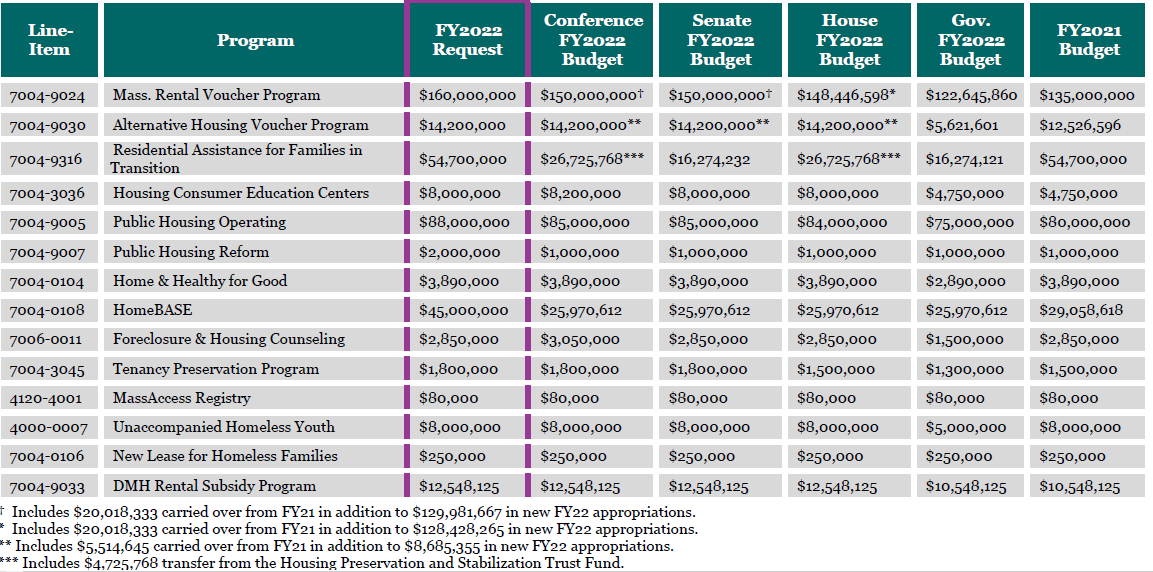
On July 8, 2021, the conference committee released for the FY2022 state budget released its conference report, which reconciled the differences between the House and Senate budget proposals.
For each of CHAPA’s priorities, the budget contains the higher appropriation amount from the versions passed by the House or Senate.
The conference budget makes language changes to several of CHAPA’s priorities including MRVP, AHVP, RAFT, and HomeBASE. This language analysis of CHAPA’s priorities in the FY2022 conference budget details the changes the budget makes compared with last year’s state budget.
The Hose and Senate are expected to quickly vote to accept the conference budget and send it to the Governor. He will have 10 days to sign the budget or send it back to the Legislature with vetoes or other recommendations.
CHAPA thanks Speaker Mariano, Senate President Spilka, Ways and Means Chairs Rep. MIchlewitz and Sen. Rodrigues, and other members of the budget conference committee for their strong support for these critical programs in the state budget.
Thanks also for everyone’s advocacy throughout the budget process!
Table with Overview of FY2022 Priorities in Conference Budget
by iwd Tina | Jun 24, 2021 | Housing News
On Thursday, June 24, 2021, the Biden administration extended the Centers for Disease Control and Prevention (CDC) eviction moratorium for 1 month from June 30th to July 31st. The CDC advised that this is intended to be the final extension to its moratorium, which has helped millions of tenants who are unable to make rent payments during the COVID-19 pandemic. As of the end of March, 6.4 million American households were behind on their rent, according to the Department of Housing and Urban Development (HUD). As of June 7th, roughly 3.2 million people in the U.S. said they faced eviction in the next two months, according to the U.S. Census Bureau’s Household Pulse Survey.
This final extension allows for the $46 billion in emergency rental assistance from Congress to continue to be provided to tenants nationwide. Of this total, Massachusetts and its local governments have received over $800 million in emergency rental assistance. Most of these funds are being administered through regional housing agencies and you can learn more about how to apply for emergency rental assistance here.
by iwd Tina | Jun 22, 2021 | Housing News
On June 21, Governor Baker introduced a plan to immediately use $1 billion of the Commonwealth’s federal aid from the American Rescue Plan Act (ARPA) for housing and homeownership. The $2.9 billion plan also included priorities related to economic development and local downtowns, job training and workforce development, health care, and infrastructure.
Specifically, the plan proposes the following for housing, per the state’s website:
- $300 million to support expanded homeownership opportunities, focused on first-time homebuyers who are residents of disproportionately impacted municipalities;
- $200 million to support housing production through MassHousing’s CommonWealth Builder Program and similar efforts, which aim to help communities of color build wealth by promoting home ownership among residents of disproportionately impacted municipalities;
- $200 million to fund rental housing production and provide increased housing options to workers and residents of disproportionately impacted municipalities;
- $300 million to finance the statewide production of senior and veteran housing. These new housing options would contain a supportive services component, and would be combined with other resources including Low-Income Housing Tax Credits, rental payments, and, in the case of veteran housing, VA health care.
Gov. Baker and the Legislature have disagreed about how the state’s ARPA funds should be appropriated after receiving $5.3 billion in May. The Legislature is expected to hold public hearings on the use of these funds between now and the fall before passing a spending plan. The Governor hopes his proposal will be taken up quickly.
The $5.3 billion in direct ARPA aid to Massachusetts are discretionary funds intended to support urgent COVID-19 response efforts, replace lost revenue, support immediate economic stabilization for households and businesses, and address unequal public health and economic challenges in Massachusetts cities and towns throughout the pandemic.
CHAPA will be advocating for these recovery funds to be used to support affordable housing. We will post updates as the process for distributing these funds plays out in the Legislature.
by iwd Tina | Jun 17, 2021 | Housing News
On June 17, the Baker-Polito Administration and MassHousing announced the first awards under the CommonWealth Builder program, a new $60 million program to create homeownership opportunities and build generational wealth in communities of color. MassHousing is committing $3.35 million to four projects, located in Boston, Everett, and Haverhill, which will support the creation of 33 new mixed-income homes, including 23 CommonWealth Builder homes.
Governor Baker and MassHousing launched the CommonWealth Builder program in July 2019, as the centerpiece of an $86 million state investment in moderate-income housing. The program provides subsidies to support the construction of new, moderately priced single-family homes and condominiums in the state’s 26 Gateway Cities, the City of Boston, and Qualified Census Tracts throughout the Commonwealth. The program subsidizes the production and purchase of homes restricted to moderate-income first-time homebuyers with income restrictions set anywhere between 70 percent to 120 percent of their Area Median Income.
The initial round of project commitments by MassHousing will support the creation of fourteen new mixed-income condominiums in Boston’s Roxbury neighborhood, seven new affordable homes in Haverhill and six new affordable townhomes in Everett. MassHousing is also funding the creation of two new CommonWealth Builder homes in Boston’s Jamaica Plain neighborhood, as part of a broader eight-unit affordable homeownership development. Additional project commitments will follow in the coming months.
Massachusetts has the sixth-largest racial homeownership gap in the United States. The homeownership gap between white and nonwhite residents in Massachusetts has helped drive significant disparities in household wealth. A 2015 study by the Federal Reserve Bank of Boston found that US-born black residents in the Boston area had a median net wealth of $8.
In 2018, MassHousing established the Racial Equity Advisory Council for Homeownership (REACH), a public-private working group that seeks to narrow the racial homeownership gap through demand-side interventions, including down payment assistance, homebuyer training, and marketing of high-quality mortgage products. The work of REACH led MassHousing to engage on this topic with Governor Baker and the state Legislature’s Black and Latino Caucus. The $60 million CommonWealth Builder program is a result of that ongoing dialogue.
The Commonwealth Builder program will grow the state’s stock of moderately priced starter homes, and advance intergenerational wealth-building in underserved communities. MassHousing has set a goal of creating roughly 500 new affordable homes through this new initiative.
MassHousing’s Homeownership Division will support the CommonWealth Builder program through a combination of mortgage financing for homebuyers, down payment assistance loans, mortgage insurance with job-loss protection at no added cost, and targeted marketing in the Gateway Cities to ensure that borrowers of color are made aware of this new opportunity for homeownership.
As of June, 2021, MassHousing had 27 projects in its CommonWealth Builder pipeline, representing $76.5 million in financing demand.
Committed CommonWealth Builder Projects:
2147 Washington Street, Boston
2147 Washington Street is a mixed-income, mixed-use building to be constructed in Boston’s Nubian Square. The project is being developed jointly by New Atlantic Development and DREAM Development, with support from Haley House and Boston’s Department of Neighborhood Development.
When complete, 2147 Washington Street will transform a city-owned parking lot and an adjoining lot controlled by Haley House into 12 new mixed-income condominiums, 62 affordable and workforce rental units, and commercial and maker space. MassHousing is contributing $1.2 million in CommonWealth Builder funds to support the creation of 8 affordable condominium units, four of which will be sold to households at or below 70 percent of the Area Median Income, and four of which will be sold to households at or below 100 percent of AMI. The remaining four condominiums will be sold at market rates. The City of Boston contributed $1.3 million to project’s homeownership component.
The project’s rental component will be built utilizing resources from MassHousing, the Department of Housing and Community Development, and the City of Boston. Construction will begin this fall.
Call Carolina, Boston
Call Carolina is an eight-unit condominium townhouse development built by the non-profit Jamaica Plain Neighborhood Development Corporation (JPNDC). The project will construct family-sized townhomes along the Southwest Corridor Park. The site includes a parcel that was originally cleared as part of the Southwest Expressway highway expansion project and subsequently acquired by JPNDC from MassDOT in 2018.
MassHousing is contributing $300,000 to the project, to support the creation and sale of two moderate-income units affordable to first-time homebuyers; the remaining six units will be affordable to homebuyers earning up to 80 percent of AMI, in accordance with the terms of sale from MassDOT. The City of Boston contributed $1.3 million in affordable housing funding, and MassDevelopment contributed $120,000 in brownfields funding. The MassHousing funding allowed JPNDC to create a fully affordable homeownership project, with more units for sale than would have otherwise been possible. Construction is underway and home sales will begin later this year.
Saint Therese Townhomes, Everett
The Saint Therese Townhomes project will create six new affordable homeownership opportunities in Everett. The sponsor is the non-profit The Neighborhood Developers, Inc. (TND). TND is constructing the St. Therese Townhomes in conjunction with a 77-unit affordable rental development, and pursued homeownership at the site as the result of community input. Three of the family-sized townhomes will be affordable to moderate-income households earning up to 80 percent of AMI, and three will be affordable to middle-income households earning up to 120 percent of AMI.
MassHousing is committing a total of $900,000 in CommonWealth Builder funds to the project. Other funding sources include $410,000 in HOME funds from city of Everett, through the North Suburban HOME Consortium, and a $250,000 Housing Choice grant from the Commonwealth. TND began construction in the spring of 2021.
Mount Washington, Haverhill
Mount Washington will transform a formerly blighted church property into seven new affordable townhomes for first-time homebuyers. The sponsor, Bread and Roses Housing, is a nonprofit housing developer and community land trust operator based in Lawrence. Two units will be restricted to buyers earning up to 70 percent of AMI, and five units restricted at 120 percent of AMI. The community land trust model, which separates land costs from the cost of homeownership, will allow Bread and Roses Housing to create deep and lasting affordability: Homes at Mt. Washington will sell between $150,000 and $225,000.
MassHousing is committing a total of $950,000 to the project. Other funding sources include HOME funds from the City of Haverhill and private philanthropic funds. Home sales commenced in the spring of 2021.
by iwd Tina | Jun 16, 2021 | Housing News
On June 16, 2021, Governor Baker signed a law extending certain pandemic-era policies. Many of the policies established during the pandemic were tied to the end of the state of emergency, which expired on June 15, 2021. The new law extends certain pandemic policies including eviction protections for tenants and allowing public meetings to be held virtually.
For eviction protections, the law:
- Requires courts to delay eviction cases if there is a pending application for emergency rental assistance applications. This protection is in place through April 1, 2022;
- Removes the connection of these state eviction protections from the end of the Federal CDC moratorium;
- Continues to require property owners to provide information on rental assistance and any relevant information on evictions with the Notice to Quit
- Also requires property owners to include documentation of any agreements between the tenant and landlord for the tenant to repay the landlord for non-payment of rent;
- Continues to require property owners to send copies of notices to quit to the Executive Office of Housing and Economic Development;
- Continues to require courts to report data on eviction cases to Legislature until April 1, 2022; and
- Continues to require the Department of Housing and Community Development to report data on the Eviction Diversion Initiative to the Legislature until January 1, 2023.
The Legislature originally established these eviction protections in December 2020.
For policies related to virtual public meetings, the law allows public bodies to continue providing live, “adequate, alternative means” of public access to public meetings. The law also authorizes all members of a public body to continue participating in meetings remotely.
CHAPA thanks Governor Baker for signing the bill into law. CHAPA also thanks the Legislature for leading the effort on the policy extensions, specifically CHAPA thanks Senate President Spilka, House Speaker Mariano, Ways and Means Committee Chairs Sen. Rodrigues and Rep. Michlewitz, and members of House and Senate for extending eviction prevention provisions from the pandemic era.
by iwd Tina | Jun 14, 2021 | Housing News
by iwd Tina | Jun 9, 2021 | Housing News
The Senate Ways and Means Committee on Tuesday advanced a pandemic policy extension bill S.2467, that would continue many of the pandemic-era policies beyond the June 15th, end of the COVID-19 state of emergency. It includes some changes and extensions to the eviction prevention law passed in Dec 2020 — Chapter 257 of the Acts of 2020 — that established certain eviction protections and policy changes for tenants.
The bill extends Chapter 257 tenant protections until April 1, 2022. Specifically, the bill:
- Removes the connection of Eviction protection law to the Federal CDC moratorium after it ends;
- Continues to require landlords to provide information on rental assistance and any relevant information on evictions with the Notice to Quit (it is set to expire on June 30th 2020);
- Continues to require property owners to send copies of notices to quit to Executive Office of Housing & Economic Development (EOHED);
- Requires courts to grant continuances for eviction cases for pending rental assistance applications until April 1st, 2022;
- Requires courts to continue reporting to Legislature until April 1st, 2022; and
- Continues to require Dept. of Housing and Community Development (DHCD) to report on eviction diversion initiative to the Legislature until January 1st, 2023.
Analysis of the amended Chapter 257 language as proposed by the Senate Ways & Means Proposal.
CHAPA thanks Chair Rodrigues and members of the Senate Ways & Means Committee for extending eviction prevention provisions from the pandemic era. This will help ensure housing stability for many households in Massachusetts beyond the state of emergency.
The Senate plans to take up the bill during a formal session on Thursday, June 10th.
by iwd Tina | Jun 8, 2021 | Housing News
The state’s COVID-19 emergency declaration is set to end on June 15. The Legislature is working on extending some pandemic-era policies beyond the state of emergency that would otherwise expire without legislative action. The State Senate is expected to take up legislation on June 10 with the Massachusetts House taking up legislation soon after.
The State Senate has indicated that it will work to extend emergency flexibilities for town meetings, including around quorum thresholds and remote participation in representative town meetings.
For renter protections for those impacted by COVID, laws set to expire on June 15 include the delay to eviction cases if there is a pending application by the tenant for emergency rental assistance. Requirements for landlords to provide notice of available emergency rental resources when beginning the eviction process would also expire with the end of the emergency declaration.
by iwd Tina | Jun 3, 2021 | Housing News
Testimony is available in PDF form. You can also watch the full hearing video.
June 3, 2021
Testimony of CHAPA Chief Executive Officer, Rachel Heller
Joint Committee on Housing Virtual Informational Hearing
Good morning and thank you for the opportunity to testify. My name is Rachel Heller, and I am the CEO of CHAPA, Citizens’ Housing and Planning Association.
CHAPA is a statewide affordable housing organization that encourages the production and preservation of homes that are affordable to households with low and moderate incomes and to foster diverse and sustainable neighborhoods through planning and community development.
For more than 50 years, we have:
- Advocated for opportunity. We do this at the local, state, and federal levels.
- Expanded access to housing through our coordination of the Massachusetts Homeownership Collaborative, monitor thousands of affordable homes across the state, administer MassAccess, and
- Developed the affordable housing field through trainings, forums, our Young Professionals Network and a mentorship program that we run with the Mel King Institute.
CHAPA brings together a broad group of stakeholders that represents nonprofit and for-profit developers, housing authorities, tenants, legal services, real estate attorneys, municipal officials, planners, homelessness advocacy groups, disability advocates, service providers, and community organizations.
We believe that together, we can build a better future for everyone in the Commonwealth.
This is something we’ve always done in Massachusetts – shaping the future we want for ourselves. This proactive spirit has made us leaders in education, healthcare, climate change, and the arts. And, Massachusetts has a long-standing commitment to affordable housing. We are one of a handful of states with our own state public housing stock, our own state low-income housing tax credit program, our own state rental assistance programs, our affordable housing law, Chapter 40B, our smart growth zoning program – Chapter 40R, our affordable housing preservation law – Chapter 40T, and our affordable housing production and preservation programs funded through the Housing Bond Bill. We have demonstrated that Massachusetts is innovative and that we are committed to solving problems. And, yet one big problem we face will require more funding and more solutions.
The affordable housing challenges facing our state put us at risk of losing the very things that make Massachusetts so great.
The urgency of the COVID pandemic and racial injustices demands that we rethink who we are and what we want to be as a Commonwealth.
The pandemic has been hard for everyone and has disproportionately impacted people with low incomes, people experiencing homelessness, and people of color. The Legislature, Governor, local governments, and the federal government have provided important financial resources to help people pay the rent and issued eviction moratoriums. DHCD and the regional administering agencies have continued to change programs to make them easier for people to access. Community organizations have played a vital role in helping people to apply for financial resources. This has made a huge impact on people’s lives and put a spotlight on the need for permanent affordable housing and the need to advance racial equity.
The decisions we make now determine our future and can ensure that every person can find an affordable home in the community of their choice.
We all know that housing is expensive in Massachusetts and that incomes have not kept pace with the cost of rents or home prices, leaving people across income levels struggling. People with the lowest incomes struggle the most and have the fewest options. This results in people being severely rent-burdened, people experiencing homelessness, and people potentially spending more on transportation to get to work, school, and appointments, and having to make choices between food, rent, and medicine.
All of this was exacerbated during the pandemic. In fact, the pandemic exposed a lot about our housing crisis. There is now a spotlight on housing instability, the disproportionate health and eviction impacts on Black and Brown households, and the divide between people with resources and jobs that allow them to work from home and people who do not have the choice to stay home.
Massachusetts faces a severe affordable housing shortage, and four main strategies are needed to ensure that people live in safe, healthy, and affordable homes in the communities they choose. We call these the four P’s: production, preservation, planning, and prosperity.
- We must produce more housing opportunities in every community and particularly, for people with extremely low incomes.
- We must preserve our existing affordable housing, including our state’s public housing. We must also prevent displacement by preserving the ability of households to stay in their communities.
- We must plan together as a Commonwealth for every community to create and preserve affordable housing. We must also plan for how we can protect and achieve fair housing for all.
- Finally, we must ensure prosperity of our neighbors and communities through access and opportunity. Everyone should have the opportunity to live in safe, healthy, and affordable homes in the communities they choose, free of discrimination and with opportunities for economic mobility and to achieve their dreams.
Diving deeper into these strategies, with regards to housing production, our needs are well documented. The Governor has set a goal of adding 135,000 new homes by 2025 and the Metro Mayors Coalition has set a goal of 185,000 new homes by 2030. MAPC states that we need 435,000 homes by 2040 with nearly two-thirds being multifamily. The Federal Reserve Bank of Boston released a report that found Massachusetts has a shortage of over 140,000 affordable homes for households with extremely low incomes.
Meeting these goals is important for stabilizing our housing market, growing our economy, preventing displacement, ending homelessness, and reducing the need for people to live farther from their jobs and networks.
While we aim to reach these goals set by the Governor and Metro Mayors, we also need to set intentional goals for affordable housing and housing for people with extremely low incomes.
Building affordable housing is like putting together a puzzle. We need zoning in place, financing to build it, and operating assistance to make it deeply affordable. In the case of supportive housing, we also need to fund services in addition to general operating costs.
In 2018, the Legislature passed and the Governor signed a $1.8 billion housing bond bill. In the recent economic development bill, the Legislature doubled funding for the Low Income Housing Tax Credit. In both the House and Senate budget proposals, there are increases for rental assistance programs, MRVP and AHVP. Thank you for these critical investments and for your continued support for the growth of these programs.
Funding from the bond bill and rental assistance in the budget will support the development of homes that are affordable to people with extremely low, low, and moderate incomes.
In addition to producing more homes, we need to preserve affordable housing as well as preserve people’s ability to live in the neighborhoods that they have called home and preventing displacement. This requires funding from the housing bond bill, funding public housing and rental assistance, providing legal counsel for tenants at risk of evictions, and potential policies and funding to acquire housing in communities at risk of displacement.
Expanding our affordable housing supply requires planning. We need to plan for more housing, more housing in locations around transit, town centers, and areas of infrastructure, supporting people’s ability to move without relying on cars. We need to plan for equitable development, ensuring we invest in people and communities who have been excluded from individual and community wealth building. For all of the critical funding provided by the state and local governments, funding can only build what is allowed to be built in communities across the Commonwealth.
The Legislature made tremendous progress on this at the end of last session with the passage of the economic development bill that includes Housing Choice and multifamily zoning requirement for MBTA communities. This will make it easier to build the kind of housing we need the most and the kind of housing that has been the hardest to build because of local opposition to housing development.
And, more needs to be done. We need more housing opportunities in every community that is near town centers and other infrastructure. This means requiring all communities to zone for multifamily housing and allow accessory dwelling units by right. It means allowing inclusionary zoning through a simple majority. We need to examine how greyfields, or underutilized properties, can be used for housing. We should look at state-owned land and prioritize affordable housing development where appropriate.
And, we need to produce, preserve, and plan for more housing so that all people have the opportunity to prosper. Prosperity means that people have the opportunity to live in safe, healthy, affordable housing in any community they choose, free of discrimination, and with access to economic mobility.
As part of this work, we must acknowledge our history of discriminatory housing and land use policies that has resulted in the fifth largest racial homeownership gap in the country. Closing the racial homeownership gap and ensuring that affordable housing programs enable Black and Brown households to build wealth, is vital to righting the wrongs of the past.
Policies like redlining, exclusionary zoning, and other discriminatory housing policies are reinforced every day in our communities and they have long-term impacts. The effects of redlining and present-day discriminatory lending have us at an unbelievable, unacceptable situation where the median net worth of white households in Greater Boston is $247,500 and the net worth of Black households in Greater Boston is $8, as you have likely seen in the Globe spotlight series. This, in addition to discriminatory lending practices, impacts people’s ability to become homeowners, impacting their economic mobility.
These are big challenges and they are achievable. We can meet our housing goals so that every person has the ability to live in safe, healthy, and affordable homes in the communities they choose. We can build upon the programs we have created, use the federal recovery dollars to advance affordable housing production, and support housing development in our communities. The Legislature has led on so many of these policies and programs. This session is another opportunity to make progress and expand access and opportunity across the state.
Thank you for the opportunity to testify. Please reach out to CHAPA as a resource. If we don’t have the answer, we likely know who you can talk to in order to learn more about your questions, concerns, and ideas for policy proposals.
Thank you.